Room Acoustics and Monitoring: Fundamentals for Sound Fidelity in Professional Production
Optimizing the listening environment for critical decisions in mixing and mastering. Key aspects of monitors, acoustic treatment, and calibration.
Fundamentals of Sound Perception and Environment Reliability
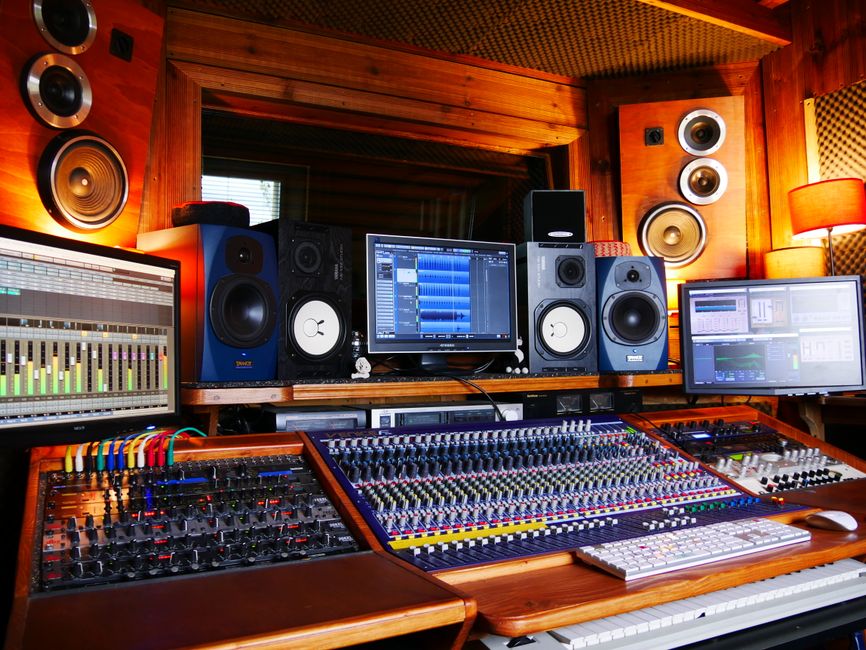
Accuracy in sound perception is fundamental for any audio professional. A well-configured monitoring system and an acoustically optimized room are pillars that support critical decisions during mixing and mastering. A unreliable listening environment can lead to productions with tonal and dynamic deficiencies that do not translate correctly on other playback systems, affecting the final quality of the work.
The human ear is a complex tool susceptible to fatigue. Therefore, training active listening and developing a solid auditory memory are essential practices. This involves the ability to identify problematic frequencies, dynamic imbalances, and the spatial coherence of a mix. A transparent monitoring system facilitates this process, allowing the engineer to focus on the nuances of the audio without the equipment introducing colorations or distortions. Consistency in listening, through regular and controlled sessions, enhances auditory acuity and informed decision-making.
Key Components of a Studio Monitoring System
The key components of a monitoring system include studio loudspeakers, the audio interface, and cabling. Active monitors, with integrated amplification, offer a practical and optimized solution. It is crucial to select monitors that present the flattest possible frequency response, minimizing peaks and dips that could mislead the ear. Brands like Neumann or Genelec are benchmarks in this area, offering solutions that prioritize neutrality. The audio interface, on the other hand, must ensure high-quality digital-to-analog conversion, preserving signal integrity. Cabling, often underestimated, also plays a role; using balanced, good-quality cables reduces interference and noise, ensuring clean signal transmission.
The control room acoustics exert a decisive impact on sound perception. Early reflections, modal resonances, and excessive reverberation times can mask critical mix details. Implementing acoustic treatment, such as absorbent panels, diffusers, and bass traps, is indispensable for mitigating these issues. The strategic placement of monitors, forming an equilateral triangle with the listener’s position (the sweet spot), is a standard starting configuration that optimizes stereo imaging and phase response. The distance from walls and monitor height should also be carefully adjusted to minimize acoustic artifacts.
Impact of Room Acoustics and Physical Treatment
Current technological innovations offer valuable tools to complement physical acoustic treatment. Room correction software like Sonarworks Reference [https://www.sonarworks.com/] or IK Multimedia ARC System [https://www.ikmultimedia.com/products/arcstudio/] analyzes the room’s frequency response and applies digital equalization to compensate for deficiencies, achieving more accurate listening. These systems are particularly useful in studio environments with space or budget limitations for extensive acoustic treatment.
Monitoring system calibration is a final yet fundamental step. Using a Sound Pressure Level (SPL) meter to adjust monitor levels to a standard reference volume, such as 83 dB SPL for the center channel or 79 dB SPL per channel in stereo configurations, ensures consistency between sessions and studios. Playing pink noise allows for an initial verification of the tonal response. Furthermore, using reference tracks (high-quality professional recordings) is an invaluable practice for comparing one’s own mix against industry standards, adjusting tonal and dynamic balance. The evolution towards immersive audio formats, such as Dolby Atmos [https://developer.dolby.com/technology/dolby-atmos/dolby-atmos-music/], introduces new challenges and requirements for monitoring, demanding multichannel configurations and even more complex calibrations, often assisted by automated time and level alignment systems.
Digital Acoustic Correction and System Calibration
For sound engineers in Argentina and the entire region, understanding and applying these principles is vital for producing audio content that competes globally. Reliable monitoring not only perfects sound but also optimizes workflow and minimizes the need for costly revisions. Investment in a precise listening environment directly translates into the final quality of the musical production, elevating the standard of every project.
Related Posts

Abbey Road Studios: Acoustic Architecture and Technological Evolution in Sound Innovation
A journey through Abbey Road's sonic infrastructure, from its origins to the digital and immersive era.
Mastering Adaptation: Auditory Profile and Distribution Platforms in the Digital Age
Sonic optimization for diverse audiences and streaming platforms. Analysis of emerging techniques and technologies.

FM Synthesis: Principles, Parameters, and Applications in Modern Music Production
Explore Frequency Modulation (FM) synthesis, its mechanisms, key parameters, and its lasting impact on contemporary music production.

Granular Vocal Synthesis: Timbral Deconstruction and Reconfiguration with AI and Advanced Tools
Explore advanced human voice manipulation using granular synthesis, AI, and digital tools for innovative sound design.