Spectral Analysis: Fundamentals and Applications in Modern Audio Engineering
Visualize and optimize sound. Learn to interpret spectra for precise mixing and mastering.
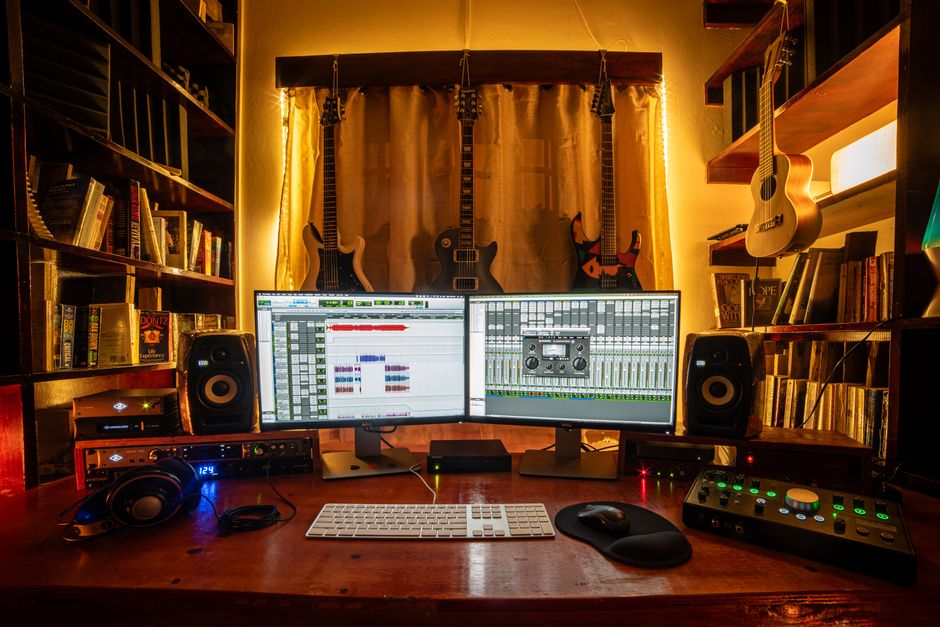
Principles of Spectral Decomposition and the Fourier Transform
Spectral analysis represents a fundamental methodology in contemporary audio production. It allows engineers and producers to visualize the energy distribution of a sound signal across its frequency range. This detailed observational capability is crucial for understanding timbral composition, identifying acoustic issues, and optimizing sound quality in various contexts, from mixing to mastering. A thorough understanding of this discipline empowers informed decision-making, resulting in productions with greater clarity and balance.
Fundamental Principles of Spectral Decomposition: The core concept behind spectral analysis lies in the Fourier transform. This mathematical principle decomposes a complex audio signal, which exists in the time domain, into its individual frequency components. Each component is characterized by its frequency and amplitude. In practice, a spectrum analyzer graphically represents this information, displaying frequencies on the horizontal axis (X) and their respective amplitudes (volume) on the vertical axis (Y). Spectral resolution, meaning the precision with which close frequencies are distinguished, and temporal resolution, the ability to show rapid changes in the spectrum, are configurable parameters that directly impact visualization and observed detail. Understanding how these resolutions interact is vital for accurate interpretation, as higher resolution in one domain often implies lower resolution in the other.
Spectral Visualization Tools and Their Interpretation
Visualization Tools and Their Interpretation: Current digital production environments integrate spectrum analyzers as standard tools within DAWs or via specialized plugins. These instruments offer various visualization modes:
- Curve Mode (Linear or Logarithmic): Presents the amplitude of each frequency at a given instant, ideal for identifying resonant peaks or dips.
- Waterfall Mode: Shows how the spectrum evolves over time, revealing frequency dynamics and persistent issues.
- Sonogram or Spectrogram: Offers a two-dimensional representation of time (X) and frequency (Y), with amplitude encoded by color or intensity, useful for visualizing a sound’s “footprint.”
- “Peak and Decay” Mode: Allows adjustment of the analyzer’s response speed, essential for perceiving sustained or transient energy in frequencies. The correct interpretation of these representations enables professionals to identify, for example, frequency masking between instruments, unwanted resonances in voice recordings, or excessive energy in certain bands that could lead to listening fatigue.
Practical Applications in the Audio Workflow: The implementation of spectral analysis is transversal across multiple production stages.
- Identifying Frequency Conflicts: It allows for precise identification of where two instruments or vocal elements compete for spectral space. For instance, if a bass and a kick drum share too much energy in the 60-80 Hz region, the analyzer will reveal that overlap, suggesting equalization adjustments to create separation and clarity.
- Surgical Equalization: With precise visualization, it’s possible to apply narrow-band equalization filters to attenuate problematic resonances without significantly affecting the rest of the spectrum. This is particularly useful in audio restoration or correcting deficient recordings.
- Analyzing Timbres and Textures: By studying the spectrum of different instruments, one gains a deep understanding of their harmonic composition. This knowledge is invaluable for sound design, synthesis, and selecting instruments that complement a mix.
- Comparison with References: Contrasting the spectrum of one’s own mix with that of a professional reference track helps evaluate the overall tonal balance and identify significant deviations, guiding decisions in the mixing and mastering process.
- Monitoring Noise and Artifacts: Spectral analysis facilitates the detection of low-frequency noise (rumble), hum, or excessive sibilance, elements that are often difficult to perceive solely by ear.
Practical Applications of Spectral Analysis in Production
Current Trends and Technological Innovations: The field of spectral analysis is constantly evolving, integrating significant technological advancements. Contemporary tools, such as plugins from the iZotope RX suite [https://www.izotope.com/en/products/rx.html] or FabFilter Pro-Q 3 [https://www.fabfilter.com/products/pro-q-3-equalizer-plugin], incorporate not only advanced visualizations but also intelligent spectral processing. Artificial intelligence (AI)-based algorithms, present in solutions like Sonible smart:EQ 3 [https://www.sonible.com/smartbundle/smarteq3/], can automatically analyze a signal’s spectrum and suggest equalization adjustments to resolve masking issues or improve tonal balance, streamlining workflows.
In the realm of immersive production, such as audio for Dolby Atmos [https://www.dolby.com/technologies/dolby-atmos/], spectral analysis extends to understanding the spatial distribution of frequencies, allowing engineers to place sonic elements with greater precision in three-dimensional environments. Furthermore, in remote and collaborative production, the use of spectrum analyzers becomes indispensable for ensuring tonal and frequency consistency across different studios and monitoring systems, a common challenge today. The ability to meticulously observe a signal’s frequency content is, therefore, more relevant than ever, adapting to the demands of new consumption platforms and high-resolution audio formats.
Conclusion: The application of spectral analysis is a methodological pillar for any audio professional seeking excellence in their productions. It goes beyond simple visualization; it constitutes a diagnostic tool that complements auditory perception, enabling precise and informed intervention. Integrating this perspective into the creative and technical process not only refines mixing and mastering skills but also fosters a deeper understanding of sound, elevating the final quality of any musical or audiovisual project. Continuous innovation in software and algorithms promises a future where spectral analysis will be even more intuitive and powerful, solidifying its position as an essential component in the modern producer’s arsenal.
Related Posts

Psychoacoustics and Measurement Tools for Virtual Presence in Immersive Audio
Exploring psychoacoustic indicators and technical tools for modeling spatial sound perception in modern productions.

Audio Mastering for Streaming: LUFS Standards, Dynamic Processing, and Codec Optimization
Explore the technical fundamentals of audio mastering for streaming platforms, covering LUFS, dynamic processing, and codec selection.

Capturing and Processing Prepared Instruments: Acoustic and Digital Methodologies for Expanded Sonorities
Technical approach to recording and post-production of prepared instruments, optimizing textures and timbral color with modern tools.

Criteria Studios: A Legacy of Innovation and Sonic Excellence in Global Music Production
The evolution of Criteria Studios, from its Miami origins to embracing immersive audio and AI.