Universal Audio 1176 vs. Teletronix LA-2A: Classic Analog Compressor Comparison
Technical comparison of the 1176 FET and LA-2A optical compressor: features, applications, and synergies in modern production.
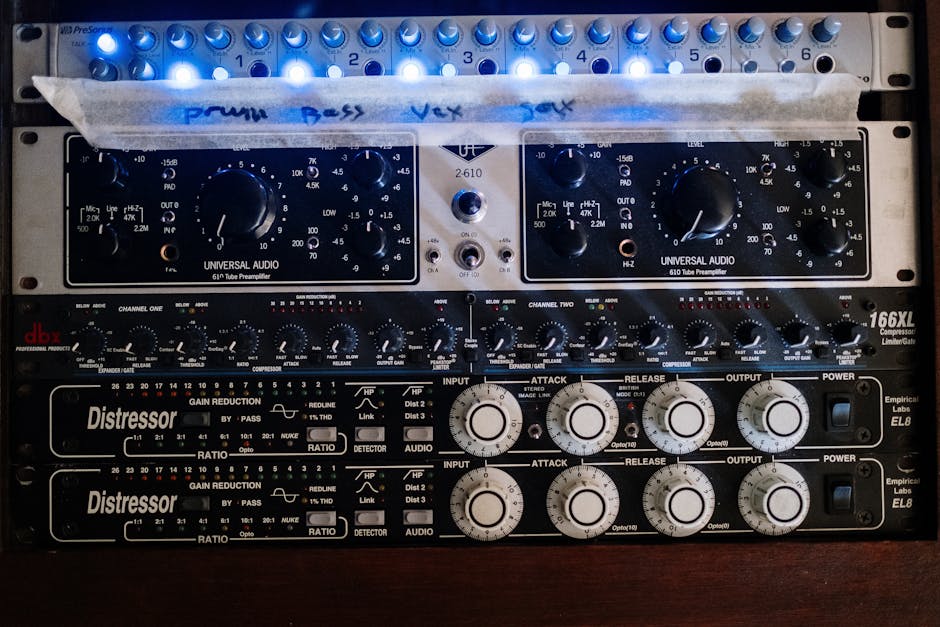
Universal Audio 1176: Fast-Response FET Processor
In the vast universe of audio processing, two analog compressors stand as unshakeable pillars: the Universal Audio 1176 and the Teletronix LA-2A. These units, with decades of history, continue to be essential benchmarks in studios worldwide, from major capitals to the most intimate home studios. Their sonic legacy endures, even in a landscape where digital tools and artificial intelligence constantly redefine mixing and mastering methodologies. Understanding the sonic particularities of each is fundamental for any producer or engineer seeking to sculpt sound with precision and character.
The Universal Audio 1176: An agile FET processor
Teletronix LA-2A: Optical Compression with Tube Warmth
The 1176, first introduced in 1967, is a solid-state compressor based on Field Effect Transistor (FET) technology. Its design grants it exceptionally fast attack and release times, making it ideal for controlling transient peaks and adding a distinctive “punch” to signals. This processor is distinguished by its ability to generate pleasing harmonics, imparting a bright quality and a sense of closeness to the sound. It is commonly used on vocals to achieve presence and consistency, on drums to accentuate the snare “crack” or kick drum “thump,” and on bass to define its attack. Its aggressive character and ability to color the signal make it a preferred choice when pursuing a more energetic and forward sound quality in the mix. Modern digital emulations of the 1176, available as plugins on platforms like Universal Audio UAD or Waves, faithfully replicate these characteristics, allowing their integration into hybrid workflows assisted by intelligent mixing tools that optimize the effects chain.
The Teletronix LA-2A: Optical compression with tube warmth
Sonic Disparity and Hybrid Application in Modern Production
On the other hand, the Teletronix LA-2A, released in the early 1960s, represents a diametrically opposed compression philosophy. It is an optical compressor that utilizes a photocell and a tube circuit, giving it a slower, smoother, and program-dependent response. Its sound is warm, organic, and associated with “transparent” compression that smooths dynamics without introducing audible artifacts. The LA-2A is excellent for adding thickness and sustain, being an ideal choice for vocals requiring delicate leveling and a silky character, bass guitars seeking roundness and body, or strings and pads needing greater cohesion and depth. Its less intrusive nature positions it as a tonal shaper that enriches the signal with desirable tube warmth. Today, its sound is emulated with great fidelity in plugins, and its application extends to immersive music production, where its ability to generate a sense of space and smoothness is highly valued in Dolby Atmos mixes.
Sonic disparity and practical application in today’s studio
Legacy and Continued Relevance in Audio Engineering
The main distinction between the 1176 and the LA-2A lies in their sonic impact and dynamic behavior. While the 1176 is a fast and aggressive compressor that injects energy and definition, the LA-2A offers a smooth, musical action that imparts warmth and cohesion. In practice, many engineers opt for a combined approach, using an 1176 to control initial transients and then an LA-2A to smooth and add harmonic color, creating a serial compression chain that leverages the best of both worlds. This hybrid technique has adapted to the digital age, where it is common to see hardware emulations running in parallel with more modern dynamics processors, and even with intelligent mastering algorithms that adaptively adjust compression. Cloud collaboration platforms also facilitate producers from different latitudes experimenting with these combinations, sharing presets and techniques that maximize the potential of these classics in contemporary recordings, from indie pop to alternative rock resonating in studios from Buenos Aires and beyond.
In summary, both the Universal Audio 1176 and the Teletronix LA-2A are invaluable tools, each with a unique sonic identity that makes them irreplaceable in specific situations. The choice between one or the other, or the strategic combination of both, depends entirely on the desired musical character and the mix’s objective. Their relevance in modern production underscores the timelessness of well-conceived design and the continuous pursuit of sonic textures that transcend technological innovations, maintaining their place as cornerstones of audio engineering.
Related Posts

Neuroacoustic Fundamentals and Synthesis Techniques for Virtual Presence in Audio
Analysis of spatial perception and ambisonic, binaural, and object-based technologies for immersive audio production.
Spatial Mastering: Adapting Sound Engineering for 3D Immersive Experiences
Optimizing mixes for spatial audio: principles, loudness management, and key tools for immersive delivery.

Integrating Analog and Digital Processing: A Comparative Analysis of Mixing Methodologies
Exploring synergies between analog/digital workflows, AI, and immersive audio in modern music production.

Interactive Audio Mastering: Dynamic Management, Adaptability, and Multi-Platform Delivery
Exploring mastering techniques for interactive content, focusing on dynamic range, real-time adaptation, and delivery optimization.