Nearfield vs. Midfield Monitors: Impact on Mix Translation and Acoustic Environments
Understanding the differences between nearfield and midfield monitors is crucial for optimizing studios and achieving accurate mixes.
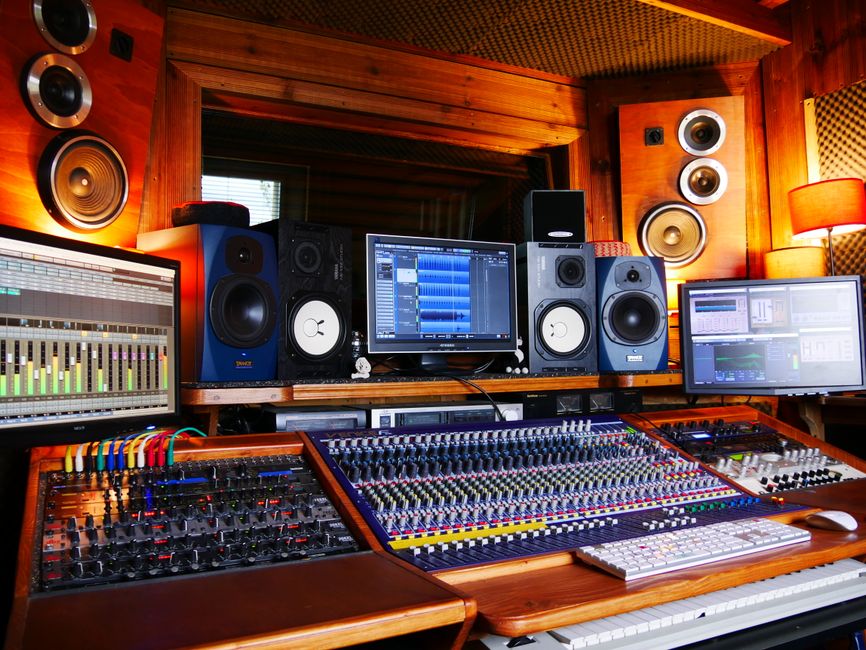
Nearfield Monitors: Acoustic Precision in Compact Environments
Critical listening accuracy is a cornerstone of music production. In modern recording studios, the choice between nearfield and midfield monitoring systems represents a crucial decision that directly impacts mix quality and translation. Understanding the specific characteristics of each setup allows engineers and producers worldwide to optimize their workspace for superior results.
The acoustic environment of an audio studio presents unique challenges. Nearfield monitors, designed for close listening distances, minimize the influence of room reflections, providing a detailed stereo image and a direct transient response. This configuration is ideal for compact studios or home studios where space and acoustic treatment may be limited. Operating at short distances, the direct sound reaches the listener with greater prominence than reflected sound, facilitating mic placement decisions and the identification of subtle mix artifacts. Many professionals use them for fine editing tasks, balancing vocals and individual instruments, or for phase verification. Current technological advancements, including integrated digital signal processors (DSP) and room correction software like Sonarworks SoundID Reference, enhance the linearity and accuracy of these systems, even in acoustically challenging environments. This allows users to calibrate their monitors and headphones for a flatter frequency response, adapting to the imperfections of any room.
Midfield Monitors: Holistic Evaluation and Broad Soundstage
On the other hand, midfield monitors are characterized by a greater listening distance, involving the room’s acoustics more significantly in the sonic perception. This makes them valuable for evaluating the overall cohesion of a mix, the relationship between elements, and how the sound will interact with larger playback systems, such as cinemas or clubs. Their ability to reproduce low frequencies with greater authority and the sense of a wider soundstage are distinctive advantages. They require larger rooms with rigorous acoustic treatment to prevent early reflections and excessive reverberation from masking critical information. Mastering studios or large control rooms often implement midfield systems, as they offer a more holistic perspective and a better representation of low-frequency energy. The expansion of immersive audio formats, such as Dolby Atmos, has further driven the relevance of longer-range monitoring systems, where spatial perception and coherence in a three-dimensional sound field are essential. These systems allow engineers to design enveloping sonic experiences that require precise acoustic space representation.
The choice between nearfield and midfield is not mutually exclusive; many professional studios use both systems to gain different perspectives on the same mix. The decision should be based on studio size, available budget, acoustic treatment, and the type of work being performed. A fundamental aspect is the periodic calibration of any monitoring system. Acoustic analysis tools and SPL meters are indispensable for ensuring that the monitors operate optimally and that the room does not introduce unwanted coloration. Furthermore, the practice of referencing mixes on various playback systems, from headphones to car audio systems, complements the information obtained from the primary monitoring, ensuring consistent translation. Advances in the development of room emulation plugins and virtual monitoring systems also offer innovative solutions for simulating different listening environments, complementing the studio’s physical setup. These tools, often powered by artificial intelligence, aim to replicate the acoustic characteristics of renowned studios or popular consumer systems, providing an invaluable additional reference.
Selecting and Calibrating Monitoring Systems in Modern Studios
In summary, both nearfield and midfield monitors possess specific attributes that make them valuable in different production scenarios. The key lies in understanding their differences, selecting the appropriate system for the particular environment and needs, and maintaining a strict regimen of calibration and referencing. The continuous evolution of audio technology continues to offer new tools for refining the monitoring experience, enabling producers worldwide to achieve unprecedented levels of precision in their sonic creations.
Related Posts

Ableton Live: Evolving Software-Hardware Interaction in Modern Music Production
An evolutionary analysis of Ableton Live software, its impact on composition, performance, and hardware-software integration.

Real World Studios: Acoustic Architecture, Technological Innovation, and Cultural Fusion in Music Production
Exploring the architecture, technology, and multicultural philosophy of Real World Studios, from its founding to immersive audio.

Sound Envelope Analysis: ADSR Modeling for Professional Audio Design and Mixing
Understand how ADSR (Attack, Decay, Sustain, Release) parameters define sound life and sculpt dynamics in productions.

Reaper: Architecture, Customization, and Evolution of a Disruptive DAW
Technical analysis of Reaper: flexible architecture, ReaScript scripting, and its impact on modern audio production.