Acoustic Holography: Physical Principles and Applications in Immersive Audio Engineering
Exploring acoustic hologram synthesis, its physical foundations, implementation techniques, and impact on immersive audio and noise control.
Fundamental Principles of Acoustic Holography
Acoustic hologram synthesis represents a technical frontier in sound manipulation, enabling the creation and reproduction of sound fields with unprecedented precision. This methodology, rooted in complex physical principles, transforms how we experience audio, paving the way for deep auditory immersion and detailed spatial control. In music production and audio engineering, understanding these fundamentals is vital for those seeking to transcend the limitations of conventional playback systems.
The core concept of acoustic holography derives from optics: the capture and subsequent reconstruction of a wave field. In the auditory realm, this involves recording the phase and amplitude information of acoustic waves emanating from a source. A reference wave interferes with the object wave (the original sound), generating an interference pattern that is recorded onto an “acoustic hologram.” Subsequently, by projecting a similar reference wave onto this hologram, the original sound field can be reconstructed in its three-dimensionality. Mathematical models, such as the Kirchhoff-Helmholtz integral, are essential for describing these wave interactions, allowing engineers to accurately model sound propagation and its spatial behavior. The analysis of how waves interact and transport energetic and directional information is the basis for their controlled manipulation.
Implementation Techniques: NAH and Sound Field Synthesis
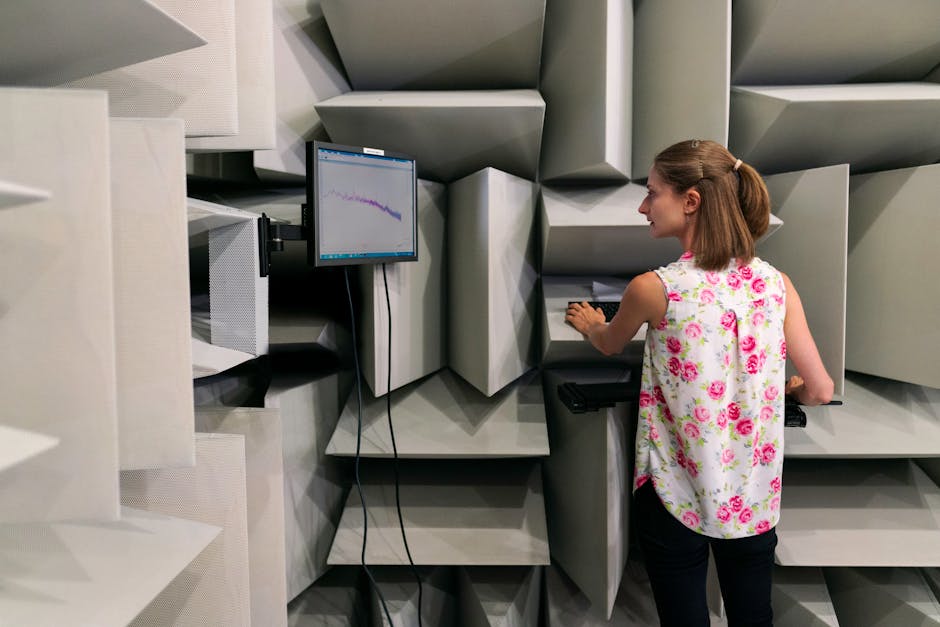
The practical implementation of acoustic holography relies on various techniques. Near-field Acoustic Holography (NAH) is a method that measures sound pressure on a surface close to the source to reconstruct its complete sound field. This allows for the identification and localization of noise sources with high resolution. On the other hand, Sound Field Synthesis (SFS), exemplified by Wave Field Synthesis (WFS), focuses on generating an arbitrary sound field using a large number of spatially arranged transducers (loudspeakers). These systems reproduce the original wavefront, creating an immersive and coherent auditory experience for multiple listeners. Computational algorithms play a crucial role, solving inverse problems for source reconstruction from measured data and direct problems for precise sound field synthesis. The optimization of these transducer arrays, now assisted by artificial intelligence, enables more efficient and adaptive sound distribution, adjusting to the specific characteristics of the space and audience.
The implications of acoustic hologram synthesis are vast and extend across multiple sectors. In immersive audio, this technology allows for the design of sound experiences that surpass traditional surround sound, creating hyperrealistic acoustic environments for film productions, video games, and virtual/augmented reality experiences. Platforms like Dolby Atmos already utilize advanced spatialization principles that benefit from these developments. In active noise control, acoustic holograms enable targeted sound cancellation for specific areas without affecting others. Acoustic beamforming allows sound to be directed with millimeter precision, a valuable capability in conferences, auditoriums, and security applications. Recent research investigates the use of new materials and transducer designs, as well as the integration of machine learning algorithms for real-time sound field rendering, dynamically adapting to user interaction. These advancements are redefining human interaction with sound, from medicine (focused ultrasound) to entertainment, offering unprecedented control over the auditory experience.
Applications and Advances in Sound Manipulation
Acoustic hologram synthesis is a fundamental pillar in the evolution of audio engineering. Its ability to manipulate and recreate sound fields with spatial fidelity opens up a range of possibilities for music creation, sound design, and acoustic research. As technology advances, with the integration of artificial intelligence and new developments in transducers, this field promises to continue redefining the limits of what is possible in human interaction with sound, driving a new era of immersive and personalized auditory experiences for audiences worldwide, including the vibrant environment of production in Argentina and Latin America.
Related Posts

AI in Mixing: Optimizing Processes and Enhancing Creative Potential in Music Production
Exploring how AI is redefining mixing, improving precision, efficiency, and sonic experimentation in music productions.

Mastering for Streaming: Navigating LUFS Normalization, True Peak, and Codecs
Sonic optimization for digital platforms: managing loudness, peaks, and lossy compression for maximum fidelity.

Advanced Vocal Vocoding: Spectral Modulation and Contemporary Applications
Exploring modern vocoder techniques, from formant manipulation to AI and immersive production.

Synthesis of Adaptive Sound Environments: Architectures, Sensors, and Real-Time Applications
Exploring the architecture, sensors, and applications of AI and ML-driven adaptive sound environments for immersive experiences.