Korg's Evolution: From Analog Oscillators to Digital Synthesis and Physical Modeling
A historical journey through Korg's innovations, from early synthesizers to contemporary sound design platforms.
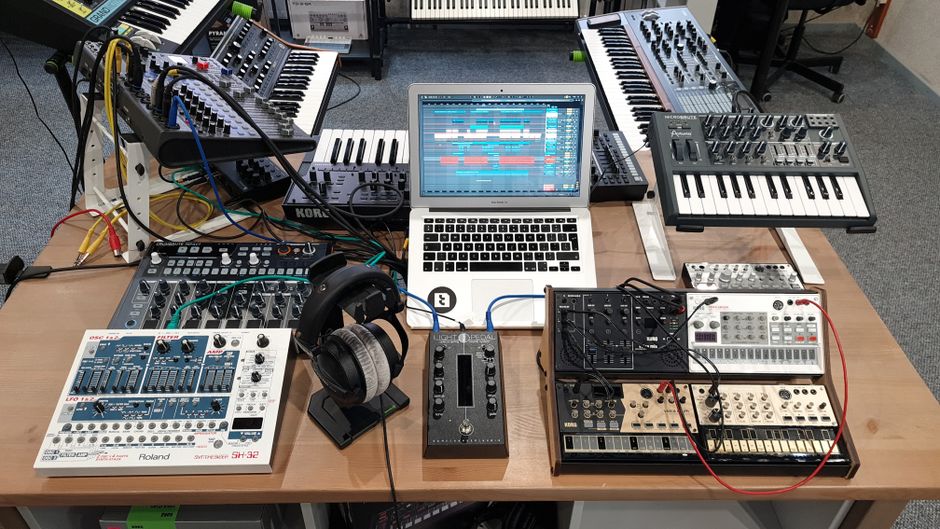
Korg’s Origins: From Drum Machines to Semi-Modular Synthesis
Korg, an iconic name in sound synthesis, has forged an unbroken path of innovation since its inception. Its influence on the landscape of electronic music and audiovisual production is undeniable, marking milestones that redefined creative possibilities and the musical experience. This historical journey examines the key developments that positioned Korg as a global benchmark, from its early analog oscillators to the contemporary hybrid platforms driving the forefront of sound design and modern composition. The Japanese firm demonstrated an exceptional ability to anticipate musicians’ needs and adapt to technological currents.
The foundations of Korg were laid in 1962, initially as Keio Electronic Laboratories, with the launch of the DoncaMatic DA-20, a rhythm machine that set the stage for future developments. However, its definitive foray into synthesis materialized with the miniKORG 700 in 1973. This accessible instrument, with an intuitive interface, allowed numerous musicians to delve into electronic timbre creation, democratizing access to the technology. Subsequently, the Korg MS-20, introduced in 1978, solidified the brand’s reputation in the semi-modular synthesizer segment. Its flexible architecture, featuring patchable routes and the ability to process external signals, enabled deep experimentation, attracting both sound engineers and avant-garde artists. The MS-20’s capacity to generate raw, powerful sounds made it a persistent favorite in genres such as techno, EBM, and industrial, maintaining its relevance to this day through hardware reissues and software versions that replicate its unique character. More information about the MS-20 mini can be found on the official Korg page: https://www.korg.com/es/products/dj/ms_20_mini/.
The Digital Revolution: Workstations and Wave Sequencing Synthesis
The 1980s ushered in a paradigm shift with the advent of digital synthesis, driven by the growing demand for more complex sounds and polyphony. Korg responded with the M1 in 1988, a workstation that redefined industry standards. Its combination of high-quality PCM (Pulse Code Modulation) sample synthesis and integrated effects, along with robust sequencing and a user-friendly interface, transformed it into the best-selling synthesizer of its era. The M1 endowed countless pop, dance, and new age productions with its characteristic pianos, organs, basses, and strings. A software version of the M1 is available in the Korg Collection: https://www.korg.com/es/products/software/korg_collection/m1.php. Following this line of innovation, the Wavestation of 1990 introduced wave sequencing synthesis, a technique that generated evolving and dynamic sound textures, significantly expanding the horizon of creating complex soundscapes and pads. Later, the Prophecy in 1995 and the Z1 in 1997 demonstrated Korg’s mastery in physical modeling synthesis (MOSS), realistically emulating acoustic instruments and creating unique sounds with unprecedented expressive control, anticipating the capabilities of modern emulation plugins.
The 21st century witnessed a renewed interest in the warmth, character, and immediacy of analog circuits. Korg embraced this trend with the Volca series, launched in 2013, which offered compact and affordable synthesizers, drum machines, and bass modules, democratizing access to analog and digital synthesis for a new generation of producers. Details of the Volca series can be found at: https://www.korg.com/es/products/dj/volca_series/. Instruments like the Minilogue (2016) and Monologue (2017) continued this legacy, providing polyphony and advanced features in compact formats with an intuitive interface that facilitated programming. These devices integrate seamlessly into hybrid studio setups, coexisting with software, advanced MIDI controllers, and modular systems, fostering experimentation in emerging genres such as synthwave, ambient, and IDM. Korg’s recent innovations, such as the Wavestate and Opsix, revitalize wave sequencing and FM synthesis techniques, respectively, incorporating modern interfaces, color screens, and advanced connectivity (USB MIDI, CV/Gate), making them ideal for immersive music production, soundtrack creation, and interaction with spatialized sound environments like Dolby Atmos. The Wavestate can be explored at: https://www.korg.com/es/products/synthesizers/wavestate/. Integration with DAWs via plugins and custom controllers underscores Korg’s continuous adaptation to contemporary production methodologies, including remote collaboration and the application of artificial intelligence algorithms in processing and assisted audio generation, consolidating its role as a key player in the present and future of music technology.
Analog Resurgence and Hybrid Synthesis in the 21st Century
Korg’s trajectory is a testament to adaptation, technological vision, and a deep understanding of musicians’ creative needs. From the rudiments of subtractive synthesis and rhythm design to the complexities of physical modeling and advanced wave sequencing, the company has provided essential tools that empowered generations of artists and music producers worldwide, from Buenos Aires to Berlin. Its unwavering commitment to innovation, maintaining a balance between emulating revered classics and exploring new sonic frontiers, secures its position as a fundamental pillar in the evolution of electronic music and global audio production. Korg’s legacy lies not only in its instruments but in the inspiration they provided for creating unique sonic universes.
Related Posts

Creative Sampling: Sound Deconstruction and Reconfiguration in Modern Music Production
Exploring decontextualization, manipulation, and audio reconfiguration for novel sonic textures and soundscapes.

Korg's Evolution: From Drum Machines to Digital Workstations and Modern Synthesizers
Exploring Korg's journey: innovation in sound synthesis, from its analog origins to its digital and contemporary contributions.

Advanced Synthesis and Sound Design in Experimental Music Production
Exploring unconventional sound sources, granular and modular synthesis, and audio processing for unique acoustic universes.

Oberheim: Sonic Architecture and Legacy in Analog Polyphonic Synthesis
Exploring modular design, pioneering polyphony, and the enduring influence of Oberheim synthesizers on electronic music.