Field Recording for Music: Principles of Capture, Processing, and Technological Innovation
Integrating ambient sounds into music: recording techniques, processing, and technological advances for innovative compositions.
Equipment and Setup for Ambient Recording
The integration of sounds captured from the environment into musical compositions represents an advanced technique that enriches the sonic palette and adds unique textures to works. This approach, known as musical field recording, transcends mere sound documentation, transforming into a creative tool for producers and composers seeking authenticity and a deeper connection with the acoustic space. Capturing environments, urban noises, or nature sounds allows for the construction of complex soundscapes and atmospheres that complement or even define the musical structure, offering an innovative perspective in contemporary auditory creation.
Instrumental Principles for Ambient Audio Capture
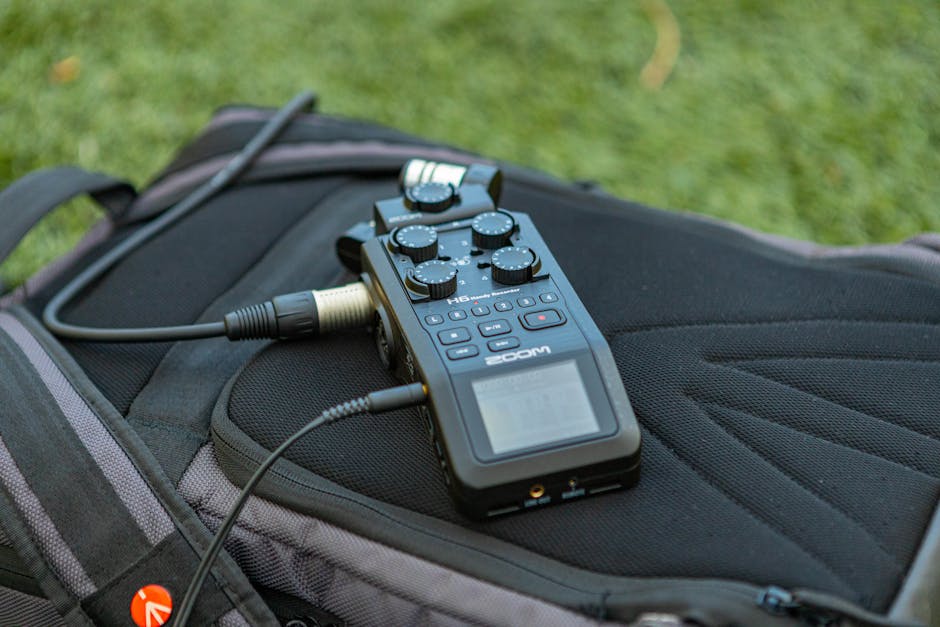
The choice of appropriate equipment is fundamental for obtaining high-fidelity field recordings intended for music production. Small-diaphragm condenser microphones, due to their extended frequency response and low self-noise, are preferable for capturing subtle details. Stereo configurations such as A/B (spaced), X/Y (coincident), or M/S (Mid-Side) are employed to achieve a precise and adaptable stereo image in post-production. Portable recorders from brands like Zoom or Tascam, with quality preamplifiers, are essential for maintaining signal integrity. Sensitivity to environmental factors, such as wind or humidity, necessitates the use of wind protection (dead cats) and waterproof covers. Prior planning, including research into the sonic environment and identification of potential interference sources, constitutes a critical step to ensure the quality of the sound material. For example, choosing an omnidirectional microphone may be optimal for recording the general atmosphere of a park, while a directional (shotgun) microphone is used to isolate the specific song of a bird.
Processing and Manipulation of Captured Sounds
Processing and Incorporating Field Sounds into Compositions
Once sound recordings are obtained, their musical value is enhanced through digital processing techniques. Selective equalization allows for the enhancement or attenuation of specific frequencies, cleaning up audio from unwanted noise or imparting a particular tonal character. Compression and dynamic expansion level the sonic range, while effects like reverb or delay can place the sound in an imaginary acoustic space. Granular synthesis is a powerful technique for deconstructing and reconstructing field recordings, generating new textures and timbres from small fragments (grains) of the original audio. Tools such as Output Audio’s Portal plugin or Max for Live’s Granulator II sampler offer extensive possibilities for this manipulation. These sonic elements can function as atmospheric layers, percussive rhythmic elements, or even as the melodic basis of a piece, transforming an everyday sound into an essential musical component. Experimentation with time and pitch manipulation using advanced algorithms in modern DAWs also contributes to the versatility of these materials.
Technological Advancements and Perspectives in Musical Field Recording
Technological Innovations in Musical Field Recording
The field of musical field recording continuously benefits from technological innovations. The implementation of artificial intelligence (AI) in audio analysis and synthesis has opened new frontiers, enabling the automatic identification of specific sounds or the generation of complex soundscapes from minimal data. Platforms like Amper Music or AIVA already use AI to assist in composition, and its application in processing field recordings promises more sophisticated tools. The expansion of immersive audio, with formats like Dolby Atmos, drives the development of ambisonic and binaural recording techniques, which allow for the creation of three-dimensional auditory experiences. Ambisonic microphones, such as those from Sennheiser AMBEO, capture the sound field in 360 degrees, providing unprecedented spatial richness for virtual reality experiences or film productions. Likewise, the use of online collaborative platforms enables artists from different geographies to share and co-create with field recordings, democratizing access to diverse sonic environments. These trends indicate a future where the integration of real-world sounds into music will become increasingly fluid, creative, and technologically advanced.
Optimizing the Capture and Editing of Sound Material
The quality of a field recording not only depends on the equipment but also on the methodology applied during capture and editing. A crucial aspect lies in constant audio monitoring using closed-back studio headphones that offer effective acoustic isolation. This allows for the identification and correction of potential issues, such as clipping or unwanted noise, in real-time. During the editing phase, the use of audio restoration software like iZotope RX becomes indispensable for mitigating background noise, removing clicks or pops, and correcting spectral imperfections. Meticulous cataloging and tagging of each sound file, including metadata such as location, date, time, and sound description, greatly facilitates its retrieval and organization in future projects. Many producers use custom databases or sound library management software for this purpose. This practice ensures productive efficiency and allows for creative reuse of the material in the long term, maximizing the value of each recording expedition. Implementing these practices optimizes the achievement of professional results, from the initial capture to the final integration into the musical work.
Field Audio Capture and Editing Methodologies
The application of musical field recording provides a unique sonic dimension to any production. By integrating environmental sounds, creators not only enrich their compositions with authentic textures but also establish a deeper connection with the listener, transporting them to specific soundscapes. The constant evolution in hardware and software, along with the exploration of advanced techniques such as granular synthesis and immersive audio, ensures that this discipline continues to be an inexhaustible source of innovation and artistic expression in the field of music and sound design. Understanding and mastering these tools and concepts will enable producers to position themselves at the forefront of contemporary sound creation, forging distinctive musical identities with the environment as the primary inspiration.
Related Posts

Electric Guitar Capture: Mic'd Amp vs. Direct Input (DI) Signal
Technical analysis of mic'd amplification and direct input (DI) methodologies for electric guitar in music production.

Beyond Rhyme: The Poetic Craft of Os Paralamas do Sucesso's Lyrics
Explore the profound lyrical artistry and enduring cultural impact of Os Paralamas do Sucesso, a masterclass for Latin American songwriters and producers.
Loudness Optimization and Spectral Processing in Mastering for Streaming Platforms
Mastering techniques for streaming: LUFS, True Peak, and dynamic processing for faithful and competitive playback.

Granular Vocal Synthesis: Fundamentals, Advanced Techniques, and Contemporary Applications
Deep exploration of granular vocal synthesis, from micro-fragment deconstruction to atmospheric textures, drones, and rhythmic effects.