Exploring Techniques and Technological Ecosystems in Contemporary Experimental Music Production
Sonic innovation and avant-garde: methodologies, granular synthesis, spatial design, and AI tools in music creation.

Sonic Innovation and Stylistic Transgression in Experimental Music
The production of experimental music represents a field where sonic innovation and the transgression of stylistic conventions converge. This artistic and technical domain invites creators to redefine the boundaries of sound, questioning pre-established harmonic, rhythmic, and formal structures. In an ever-evolving musical landscape, the experimental approach not only fosters originality but also drives the development of new creation tools and methodologies. For producers and artists in Latin America, the local context offers a rich palette of cultural and phonetic influences that can be integrated into cutting-edge sonic proposals, thereby enriching the global dialogue on contemporary music.
The conception of compositions that challenge auditory expectations requires an openness to unconventional sound creation methodologies. This involves moving beyond traditional instruments, integrating atypical sound sources such as field recordings captured in urban or natural environments, the use of found objects processed electronically, or the technique of circuit bending to modify electronic circuits and generate unpredictable timbres. Granular synthesis, for example, allows for the deconstruction of any audio sample into microscopic “grains” that can be rearranged and manipulated to create dense textures, evolving drones, or abstract rhythms. Likewise, physical modeling enables the simulation of non-existent instruments or acoustic phenomena, opening a vast universe of unheard timbres. Platforms like Ableton Live or Bitwig Studio, with their modular environments and deep modulation capabilities, establish themselves as ideal environments for articulating these explorations, allowing users to build custom instruments and effects that dynamically respond to their creative intentions. The integration of artificial intelligence tools, such as machine learning models for MIDI sequence generation or audio transformation, is beginning to emerge as a promising frontier for expanding sonic possibilities, offering new avenues for human-machine co-creation. A fascinating example of this synergy between technology and art can be found in the capabilities of Max for Live within Ableton, which extends the DAW’s functionalities through visual programming: [https://www.ableton.com/en/max-for-live/]
Methodologies for Unconventional Sound Creation and Digital Tools
Beyond the generation of singular sounds, the structuring and design of auditory experiences constitute the core of experimental production. This often involves abandoning linear musical forms and adopting random, non-linear, or soundscape-based approaches that evolve organically. The spatial design of sound acquires crucial relevance, aiming to immerse the listener in three-dimensional environments. Technologies such as Dolby Atmos Music or ambisonic systems allow for the precise placement of sound elements in a virtual space, transforming listening into an immersive experience. This approach is not only applied to music intended for streaming platforms but also to interactive sound installations or adaptive soundtracks for virtual and augmented realities, where sound reacts in real-time to user actions. Consideration of auditory perception and sound psychology are fundamental to constructing non-verbal narratives that resonate on subconscious levels, inviting active and contemplative listening. To learn more about how immersive audio is implemented in music, you can consult information from Dolby developers: [https://developer.dolby.com/platforms/dolby-atmos/music/]
The arsenal of tools and technological ecosystems available to the experimental producer is vast and constantly expanding. Modular synthesizers, particularly the Eurorack format, offer unprecedented freedom to interconnect modules and design unique signal chains, fostering serendipity and tactile experimentation. Expressive MIDI controllers, such as the ROLI Seaboard or Haken Continuum instruments, allow for a level of articulation and modulation that goes beyond the traditional keyboard, opening new interpretive dimensions. In the software realm, visual programming environments like Max/MSP or Pure Data, along with programming languages like SuperCollider or Csound, empower artists to build their own instruments, processors, and generative systems from scratch, precisely tailoring them to their visions. Remote collaboration, facilitated by platforms like Splice for project sharing or Audiomovers for real-time high-quality audio transmission, has democratized collective creation, allowing artists from different latitudes, including the burgeoning Argentine scene, to join projects without geographical barriers. This ecosystem of tools, ranging from analog hardware to cutting-edge algorithms, underscores the hybrid and technologically advanced nature of experimental music production. A valuable resource for delving into advanced synthesis and processing techniques can be found in specialized magazines like Sound on Sound: [https://www.soundonsound.com/techniques/granular-synthesis-explained]
Designing Immersive Auditory Experiences and Sound Perception
In synthesis, the production of experimental music is a field that values creative audacity and technical exploration. By integrating unconventional methodologies, designing immersive auditory experiences, and leveraging a constantly innovating technological ecosystem, creators can forge new sonic paths. This process is not merely technical but a manifestation of artistic curiosity that redefines what music can be. Continuous research and a willingness to transcend boundaries are the pillars upon which the future of sound is built.
Related Posts

Sonic Architecture in Narrative Podcasts: Vocal Processing, Spatiality, and Musical Cohesion
Technical optimization for narrative podcasts: vocal clarity, spatial depth, musical integration, and loudness standards for immersive audiences.
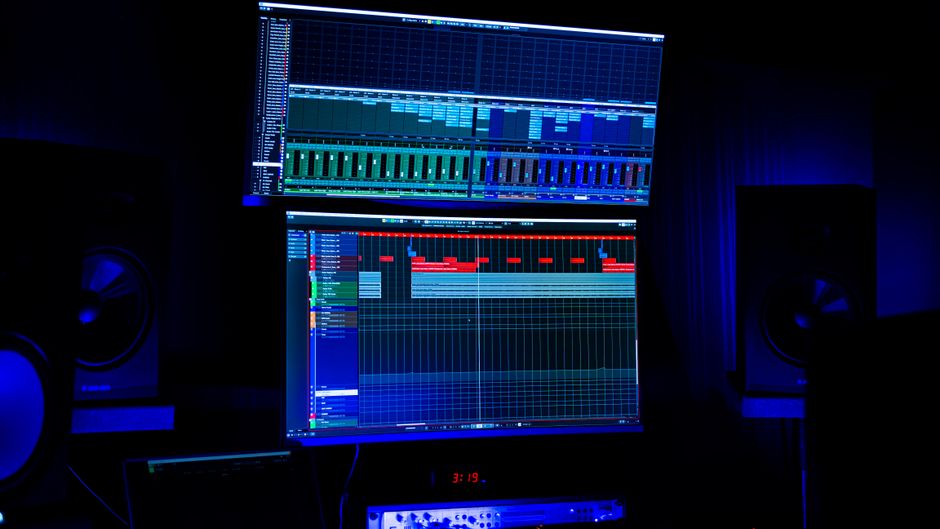
Studio One 6: Unified Architecture and Workflow for Modern Music Production
Analysis of Studio One's single interface, mix/mastering tools, and ARA2 support, optimizing sound creation.

Dynamic vs. Condenser Microphones: Operating Principles, Performance, and Key Applications
A technical exploration of the operating principles, characteristics, and practical uses of dynamic and condenser microphones.

Corrective EQ: Spectral Cleaning Strategies for Clear Mixes
Dive into subtractive, parametric, and dynamic EQ techniques to optimize sonic clarity and coherence in music productions.