Acoustic Guitar Sound Capture: Fingerpicking vs. Strumming, Techniques, and Processing
Optimize acoustic guitar recordings: compare fingerpicking and strumming techniques, miking, and processing for professional results.
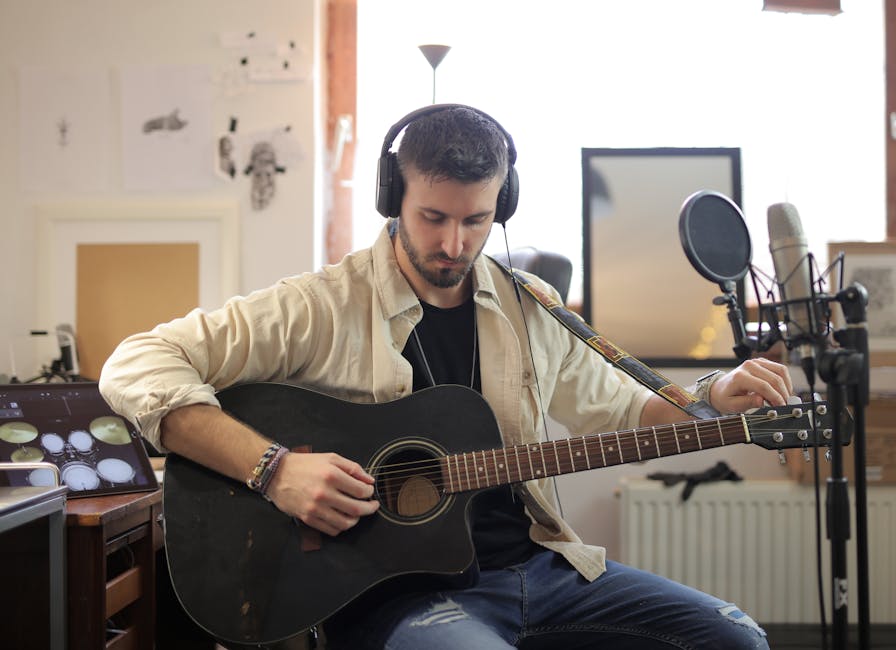
Microphone Techniques for Fingerpicking: Clarity and Dynamics
The acoustic guitar, a fundamental pillar in countless musical genres, presents distinct challenges in its sound capture. The choice between fingerpicking and strumming not only defines the harmonic texture of a piece but also demands radically different recording approaches to ensure a faithful and resonant representation in the final mix. A deep understanding of these particularities is essential for engineers and producers seeking to optimize the quality of their recordings.
Fingerpicking, characterized by its intricate articulation and the delicacy of each individually plucked note, requires meticulous attention to clarity and dynamics. For this style, small-diaphragm condenser microphones, such as a Neumann KM 184 or a Shure KSM137, are often the preferred choice due to their precise transient response and their ability to reproduce the subtlest details of string attack and guitar body resonance. Alternatively, ribbon microphones, like a Coles 4038, can offer an organic warmth and a smoothness in the high frequencies that complements the intimate nature of fingerpicking, mitigating any potential harshness. Microphone placement is critical: aiming towards the 12th fret or slightly above the soundhole, at a distance of 15 to 30 centimeters, allows for a balance of body and definition. For stereo capture that provides a wide and immersive spatial image, techniques such as ORTF or X/Y, using a pair of small-diaphragm condensers, are highly effective. Post-processing should be minimalist; subtle equalization to enhance clarity in the mid-high frequencies and gentle compression with a low ratio and slow attack can help level dynamics without sacrificing the inherent expressiveness of the style.
Capturing the Sound of Strumming: Harmonic Fullness and Rhythm
On the other hand, recording strummed acoustic guitar imposes different demands. Here, the primary goal is to capture the harmonic fullness, rhythmic impact, and energy that defines strumming, while avoiding excessive low-frequency buildup or unwanted harshness in the high frequencies. Large-diaphragm condenser microphones, such as an Audio-Technica AT2035 or an AKG C414, are excellent for this purpose, offering a wider frequency response and the ability to handle higher sound pressure levels. Some engineers also opt for robust dynamic microphones, like a Shure SM57, for a more direct and characterful sound, especially in dense mixes where the guitar needs to cut through other instruments. Distance is key: positioning the microphone 30-60 centimeters from the guitar, aiming towards the point where the musician’s arm joins the body, or slightly towards the bridge, helps capture a more balanced sound that is less prone to excessive soundhole resonance. For a bigger, more ambient sound, incorporating a room microphone, placed several meters from the source, can add depth and spatial realism. Regarding processing, corrective equalization is common to attenuate problematic frequencies (e.g., muddiness in the 200-400 Hz range or harshness in the 2-4 kHz range), and firmer compression, with a medium attack and fast release, can unify the sound and give it more presence and sustain in the mix.
Technological innovations continue to redefine the possibilities in acoustic instrument capture. The integration of high-end preamplifiers with modern audio interfaces, such as those from Universal Audio, provides exceptional fidelity and character directly into the digital workflow. Furthermore, the development of advanced audio restoration plugins, like iZotope RX, allows for addressing unwanted noise or problematic resonances with unprecedented precision, an invaluable resource for preserving the purity of fingerpicking recordings. For remote and collaborative production, platforms like Splice or BandLab facilitate interaction between musicians and producers, enabling the sharing and refinement of acoustic guitar takes from different locations. Experimentation with hybrid miking techniques, combining the direct signal from a piezo pickup or an internal system with room microphone capture, offers tonal versatility that can adapt to a wide range of musical contexts, from the most intimate folk to the most elaborate pop. These advancements provide powerful tools for producers in Buenos Aires and across Latin America to elevate the quality of their productions. For a deeper exploration of recording techniques, resources like Sound on Sound offer valuable information.
Technological Innovations in Acoustic Guitar Recording
In summary, both fingerpicked and strummed acoustic guitar recording demand a detailed understanding of their inherent sonic characteristics and a judicious selection of equipment and techniques. Success lies in the engineer’s ability to carefully listen to the needs of each performance and apply a personalized approach. Constant experimentation with different microphones, placements, and processing is crucial to finding the optimal sound that each musical piece deserves. By integrating traditional practices with the latest tools and trends, the skill of capturing the essence of the acoustic guitar with maximum fidelity and expression is refined.
Related Posts

Power Station Studios: Acoustic Legacy and Technological Evolution
Iconic studio: acoustic design, hybrid consoles, and digital adaptation define sonic excellence.

Physical Modeling in Sound Synthesis: Principles, Applications, and Future Innovations
Fundamentals of physical modeling for recreating instruments and generating unique timbres, exploring its application in modern music production.

Sound Design and Spatiality in Ambient Music Production
Technical exploration of synthesis, reverb, delay, and composition for immersive ambient soundscapes.

Live Sound Engineering: Recreating IKV's Sonic Complexity
Technical analysis of audio strategies to replicate the sonic proposal of Illya Kuryaki and the Valderramas in concerts.