Stereo Microphone Techniques and Acoustics for Faithful Piano Capture
Optimize piano recording: exploring mic techniques, acoustics, and transducers for sonic fidelity.
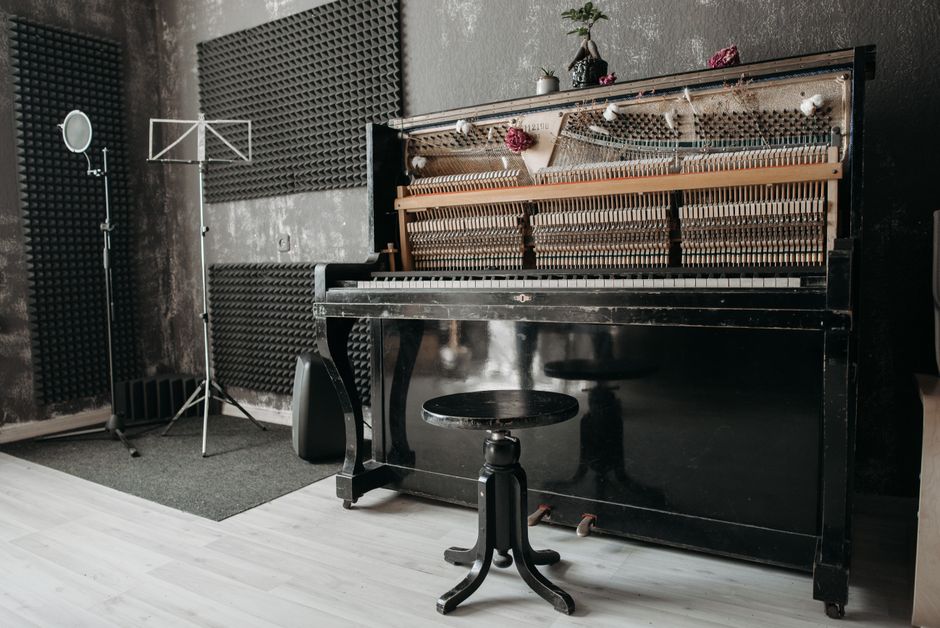
Room Acoustics and Piano Selection
Capturing the sonic essence of a piano is a challenge that merges technical expertise with artistic sensitivity. This instrument, with its vast dynamic range and frequency spectrum, demands a methodical approach to ensure faithful reproduction in any production context. From the harmonic resonances of the strings to the percussive impact of the hammers, every detail contributes to the richness of the sound. Proper microphone placement and technique are fundamental pillars for achieving a recording that preserves the piano’s articulation, body, and presence—elements crucial in contemporary music.
The acoustic environment plays a decisive role in the quality of the take. A room with controlled reverberation is preferable to avoid unwanted resonances or a “muddy” sound. It is recommended to treat the room with absorbers and diffusers, especially if the space is small or has excessive reflective surfaces. The choice of piano type—upright or grand—also directly influences the microphone strategy, given the different arrangement of its soundboard and sound projection.
Regarding transducers, large-diaphragm condenser microphones are the preferred choice due to their extended frequency response and their ability to capture transients with precision. Models like the Neumann U87, the AKG C414, or the Telefunken C12 are classic examples that offer exceptional transparency. Ribbon microphones, such as the Royer R-121, can provide distinctive warmth and smoothness, ideal for pianos with a brighter sound or for genres that require a vintage texture. Combining both types can generate a richer tonal palette. Selecting an appropriate polar pattern is equally crucial; cardioid patterns offer side rejection, useful in noisy environments, while omnidirectional patterns capture more of the room’s ambiance, imparting a heightened sense of space.
Transducers and Polar Patterns for Piano
Stereo piano recording aims to recreate the instrument’s spaciousness and spatial image. Various placement techniques yield distinct sonic results:
The Spaced Pair (A/B) technique involves placing two omnidirectional or cardioid microphones 30-60 cm apart, generally over the strings or pointing towards the soundboard. This technique produces a wide and natural stereo image, although it can introduce phase issues if the distance is excessive. Verifying mono compatibility is essential.
The ORTF technique uses two cardioid microphones angled at 110 degrees, with their capsules 17 cm apart, emulating the distance and angle of human ears. It provides a coherent stereo image with good localization, less prone to phase issues than the spaced pair, and with a balanced sense of spaciousness.
Stereo Miking Techniques for Piano
The XY configuration employs two cardioid microphones with their capsules as close as possible and angled at 90 degrees. This configuration is completely phase-coherent and offers a precise, though sometimes less wide, stereo image. It is an excellent option when mono compatibility is a priority.
The Decca Tree is a more complex setup using three omnidirectional microphones (two outriggers and one center) on a “T”-shaped bar. Originally conceived for orchestras, it can be applied to grand pianos in large rooms for a majestic and enveloping capture, integrally capturing the space’s acoustics. The precise placement of these pairs over the piano (closer to the hammers for detail, further into the tail for body, or even underneath for resonance) will determine the final character of the take.
Beyond traditional stereo techniques, modern production often integrates close-miking methods or hybrid solutions. Using contact microphones (pickups) attached to the piano’s soundboard can provide a direct capture of vibrations, useful for adding “punch” or detail in dense mixes, although their sound may be less natural. Combining a main stereo pair with a close microphone (mono) in the center of the keyboard or over the hammers allows for granular control over presence and definition.
Technological Innovations in Piano Recording
Technological innovations also impact piano recording. AI-based plugins, such as reverb or de-clipping processors from brands like iZotope or Sonible, allow for “cleaning up” recordings made in suboptimal acoustic spaces, separating the direct signal from the ambiance. This offers unprecedented flexibility in post-production. Furthermore, integrating high-quality virtual pianos (such as those from Native Instruments or Spitfire Audio) with real acoustic recordings is a common practice to enrich sonic texture, add layers, or correct imperfections. Remote production has driven the development of low-latency audio interfaces and online collaboration platforms, making it easier for musicians and sound engineers in different locations to contribute to the same piano production, sharing high-resolution files and synchronizing sessions. These advancements demonstrate how technology complements and expands the possibilities of traditional microphone techniques.
Recording a piano transcends mere microphone placement; it involves a deep understanding of acoustics, the instrument, and the musical intention. From the meticulous selection of transducers to the application of stereo techniques and the incorporation of innovative solutions, every decision affects the fidelity and emotional impact of the performance. Constant experimentation, coupled with a critical ear and adaptation to contemporary tools, are essential for achieving outstanding results that resonate with the audience in today’s dynamic musical landscape.
Related Posts

Caetano Veloso's Guitar: Techniques, Instrumentation, and Sonic Production
Technical analysis of Caetano Veloso's guitar sound: instrumentation, playing techniques, and production processes.

Microphony and Harmonic Bowl Processing: Capturing Timbre and Sonic Spaciality
Technical analysis of crystal and Tibetan bowl recording, covering mic selection, techniques, and processing.

Machine Learning in Vocal Processing: Restoration, Synthesis, and Intelligent Mixing
ML innovations for voice: audio restoration, advanced synthesis, and music mix optimization.

Nearfield vs. Midfield Monitors: Features, Applications, and Acoustic Optimization in Modern Studios
Understand the differences between nearfield and midfield monitors to optimize sound accuracy in your studio, from home setups to professional rooms.