The Evolution of Delay in Music Production: From Natural Echoes to AI-Driven Digital Processing
A journey through the history and development of the delay effect, from its origins to contemporary applications with AI and immersive audio.

Origins and Early Implementations of Delay
Delay, a fundamental pillar in music production, has shaped countless sonic landscapes throughout history. This effect, which replicates and repeats an audio signal, transcends mere reverberation to create rhythmic textures, add spatial depth, and generate immersive atmospheres. From its primary acoustic manifestations to sophisticated contemporary digital implementations, its evolution reflects human ingenuity in sound manipulation. Let’s analyze the journey of this essential processor and how its development has marked milestones in musical creation, influencing genres and production techniques.
The first echoes were natural phenomena, perceived in caves or canyons. Music, since ancient times, sought to emulate these resonances. With the advent of recording technology, the first artificial delay techniques emerged. In the mid-20th century, magnetic tape recording enabled the creation of the ‘slapback echo,’ a short and distinctive delay, highly popular in genres like rock and roll and rockabilly. This effect was generated by using two playback heads on a tape machine, where the recorded signal was read by the first head and then, with a slight delay, by the second, creating a rapid, decaying repetition. Devices like Maestro’s legendary Echoplex or Roland’s RE-201 Space Echo, which employed tape loops, became indispensable tools, allowing musicians and producers to adjust delay time and feedback, a manual process that lent a unique character to each performance. These units defined the sound of many iconic recordings of the era. For more details on the legendary Space Echo, you can consult its technical specifications on Roland’s official website: https://www.roland.com/latinamerica/products/re-201/.
Technological Evolution: From BBDs to the Digital Age
The 1970s brought a revolution with analog delays based on ‘Bucket Brigade Devices’ (BBDs). These electronic circuits stored and passed the audio signal from one capacitor to another, generating a delay with subtle, warm degradation, appreciated for its organic character and tendency to self-oscillate in extreme configurations. Pedals like the Boss DM-2 are iconic examples of this technology, still valued for their distinctive tone. Subsequently, the advent of digital technology in the 1980s radically transformed the landscape. Digital delays offered greater fidelity, longer repeat times, and the ability to manipulate parameters with unprecedented precision. A milestone was the appearance of rack units like the Lexicon PCM 42 or the Eventide H3000, which not only offered delay but also modulation and other complex effects. These units enabled sound engineers and artists to orchestrate previously unimaginable sonic textures, significantly expanding creative possibilities in renowned studios and large-scale productions. The Eventide page showcases their legacy in audio processing: https://www.eventideaudio.com/.
Today, delay predominantly manifests in software format, with countless plugins emulating or surpassing their analog and digital predecessors. These plugins offer astonishing flexibility, from precise emulations of vintage gear to experimental algorithms incorporating filtering, complex modulation, phase inversion, and advanced ‘ping-pong’ capabilities. The integration of artificial intelligence (AI) represents a recent advancement, with tools that can analyze musical context and suggest delay settings or even autonomously generate complex rhythmic patterns, optimizing the producer’s workflow. Furthermore, the advent of immersive audio, such as Dolby Atmos, has driven the development of multichannel delays that allow repetitions to be positioned in three-dimensional space, enriching the listening experience in an enveloping manner. Contemporary producers use these resources to create everything from subtle spatial extensions to elaborate rhythmic sequences that interact with the composition dynamically. The ability to synchronize delay with the project tempo in the DAW is a standard feature that optimizes rhythmic integration. An example of a modern delay plugin is Valhalla Delay: https://valhalladsp.com/shop/delay/valhalladelay/. To learn more about immersive audio, visit the Dolby Atmos for Music section: https://professional.dolby.com/music/dolby-atmos-for-music/.
Contemporary Delay: Software, AI, and Immersive Audio
The trajectory of delay, from natural echo to sophisticated AI-driven digital tools, illustrates the constant pursuit by creators to expand the sonic palette. Its adaptability and versatility solidify it as a timeless effect, indispensable in any production studio, from a home studio in Buenos Aires to large professional complexes. Understanding its evolution allows audio professionals not only to apply the effect effectively but also to innovate, employing the latest technological trends to sculpt increasingly complex and immersive soundscapes. The effect’s capacity to transcend genres and eras ensures its permanence as an essential tool in any music producer’s toolkit.
Related Posts
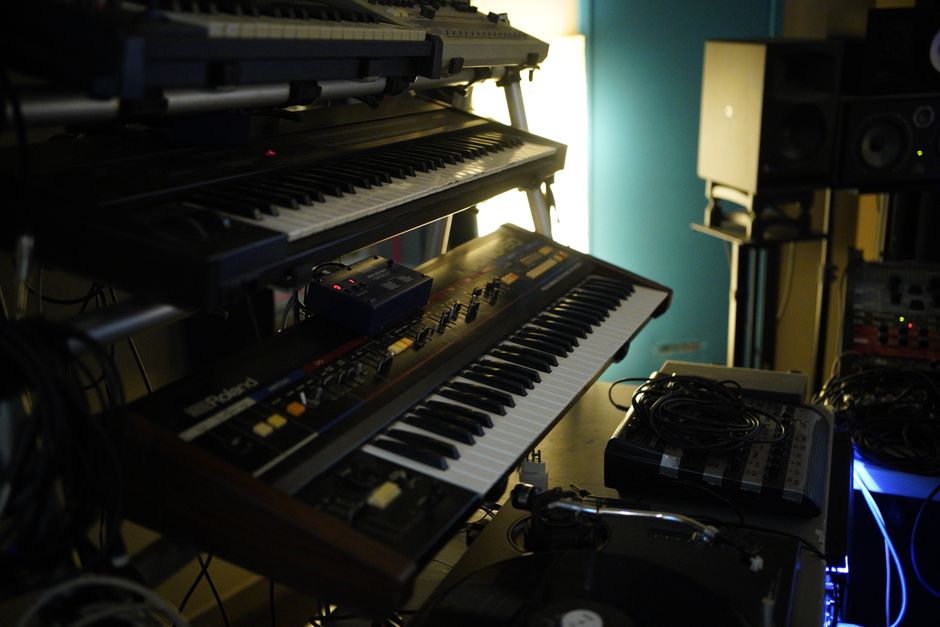
Integrating Vintage Electronic Instruments: Preparation, Capture, and Processing in Modern Workflows
Methodologies for capturing and processing vintage synthesizers and drum machines, ensuring sonic authenticity in current productions.

Spectral Coherence Analysis: Optimizing Frequency Interactions in Audio Production
Explore how spectral coherence reveals frequency interactions, optimizing mixes, alignment, and audio troubleshooting.

The Soul of Argentinian Rock: Essential Los Piojos Albums Explored
Explore the definitive discography of Los Piojos, the iconic Argentinian rock band whose blend of rock, reggae, and candombe shaped a generation.
Algorithmic vs. Convolution Reverb: Principles, Applications, and Technical Optimization
Technical exploration of algorithmic and convolution reverb: differences, operation, and application for audio engineers.