Universal Audio 1176 vs. Teletronix LA-2A: Analog vs. Digital Dynamic Processing Comparison
A deep dive into the sonic characteristics of the 1176 and LA-2A, their contemporary applications, and hybrid strategies in music production.
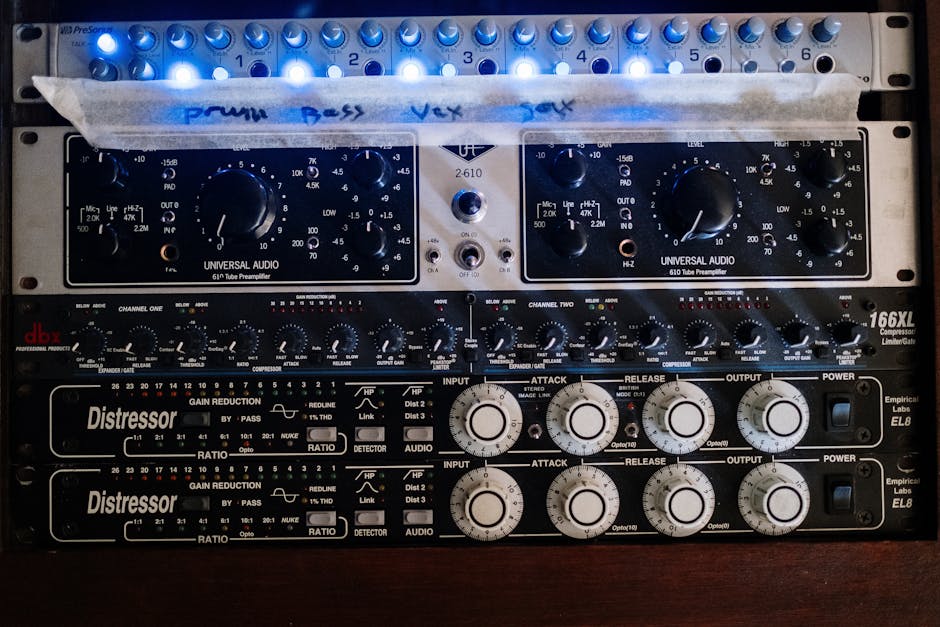
Universal Audio 1176: FET Transistor Characteristics and Transient Control
In the realm of music production, certain pieces of gear transcend their original function to become true icons. Among these, the Universal Audio 1176 and the Teletronix LA-2A stand as fundamental pillars of dynamic processing. Despite the constant emergence of new tools and innovations in audio artificial intelligence, these analog compressors continue to be indispensable references, both in their original hardware form and in their numerous digital emulations. Their legacy lies not only in their history but in the distinctive sonic characteristics each brings to a mix. This analysis delves into their particularities to understand when and how to apply each in contemporary productions.
The Universal Audio 1176: Controlled Aggression and Defined Transients
Known for its Field-Effect Transistor (FET) design, the 1176 is renowned for its exceptionally fast response time, allowing it to react to transients with an immediacy few compressors can match. Its circuit adds a characteristic harmonic coloration, often described as ‘punch’ or ‘sizzle,’ which enriches the sound without overpowering it. This compressor is a formidable ally for elements that require presence and definition. On drums, for example, it’s common to apply it to the kick or snare to accentuate the attack and give them a powerful impact. For vocals in genres like rock or pop, the 1176 allows the voice to sit at the front of the mix with vibrant energy, controlling peaks without crushing the overall dynamics. Its ‘all buttons in’ mode, an unintended configuration that became popular, generates extreme compression and harmonic saturation, ideal for creative effects on drums or bass that require a particular sonic texture. Today, plugins like the UAD 1176 Collection [https://www.uaudio.com/uad-plugins/compressors-limiters/1176-collection.html] or the Waves CLA-76 [https://www.waves.com/plugins/cla-76] faithfully replicate its behavior, serving as vital tools in studios worldwide, from Buenos Aires to Madrid, employed in genres ranging from trap to electronic folk, where precise transient control is crucial for modern aesthetics.
Teletronix LA-2A: Optical and Tube Principles for Organic Compression
The Teletronix LA-2A: Smoothness, Warmth, and Organic Compression
In contrast to the immediacy of the 1176, the Teletronix LA-2A operates on an optical and tube principle, lending it a much smoother and program-dependent response. Its gain reduction mechanism, based on a light-emitting diode (LED) and a photoresistor, results in attack and release times that naturally adapt to the incoming signal. The LA-2A is synonymous with warmth, sustain, and almost imperceptible compression that ‘glues’ the sound together without taking the life out of it. It is the preferred choice for vocals in ballads, jazz, or acoustic genres, where subtle leveling is desired to maintain emotionality and performance fluidity. It is also exceptional on bass, providing a solid and consistent foundation, or on acoustic guitars, enhancing their body and resonance. Its minimalist interface, with just two knobs (Peak Reduction and Gain), invites intuitive and musical operation. The LA-2A’s versatility extends to mastering, where its ability to add sonic ‘glue’ and pleasant harmonic saturation makes it a mix finisher. Advanced digital emulations, such as the UAD LA-2A Collection [https://www.uaudio.com/uad-plugins/compressors-limiters/la-2a-collection.html], have successfully captured the essence of this classic, enabling producers in the region to integrate its sonic character into productions seeking a balance between digital clarity and analog richness, even employing machine learning techniques to more accurately model the nonlinearities of vacuum tubes.
Specific Applications and Hybrid Strategies in Today’s Context
Hybrid Dynamic Processing Strategies and Contemporary Applications
The choice between an 1176 and an LA-2A, or the decision to use them together, depends entirely on the sonic objective. For vocals, it’s common to chain both: an 1176 managing the most aggressive peaks with a moderate ratio, followed by an LA-2A transparently leveling the signal and adding overall warmth. This combination, known as ‘cascade compression,’ offers the best of both worlds: precise dynamic control and rich sonics. On kick and snare drums, the 1176 is unsurpassed for imparting a defined ‘punch,’ while the LA-2A might be used more on a room bus or to provide smooth consistency to a bass guitar.
Current trends in music production, from the rise of Dolby Atmos to online collaborative production, have revitalized interest in these classics. Producers in Latin America, like their global counterparts, implement these emulations in their DAWs to build immersive soundscapes where spatialization does not compromise tonal quality. The integration of plugins simulating these compressors in spatial audio mixing environments, such as those offered by Universal Audio on its UAD Spark platform [https://spark.uaudio.com/], allows analog warmth to be brought into new dimensions. Furthermore, the increasing sophistication of artificial intelligence-based tools, which assist in selecting compression parameters or even model the dynamic response of these units with astonishing fidelity, underscores the enduring relevance of understanding the fundamental characteristics of the 1176 and the LA-2A. These innovations do not replace the engineer’s ear but offer new avenues for applying the character of these legendary compressors in more efficient and creative ways.
In summary, the Universal Audio 1176 and the Teletronix LA-2A are much more than simple compressors; they are tools with well-defined sonic personalities that have shaped countless musical productions. While the 1176 excels in its ability to add energy, definition, and fast dynamic control, the LA-2A shines with its smoothness, warmth, and musically organic compression. Understanding their differences and the ability to integrate them strategically, whether in hardware or software, allows engineers and producers to sculpt mixes with exceptional depth and character, adapting to the demands of an ever-evolving musical landscape and new audio technologies.
Related Posts

Psychoacoustic Principles and Advanced Tools in Musical Sound Spatialization
Acoustic foundations, M/S techniques, and immersive audio for sonic depth and width in productions.

The AES/EBU Protocol: Fundamentals of Professional Digital Audio Interconnection and Its Legacy
Analysis of the AES/EBU standard in digital audio transmission, its technical design, and continued relevance in professional environments.

Integrating Hardware Synthesizers: Capture and Processing Methodologies for Modern Production
Optimize hardware synth capture and processing, from impedance matching to AI, for hybrid workflows.
FM Synthesis: Principles, Parameters, and Applications in Modern Music Production
Explore Frequency Modulation (FM) synthesis, its mechanisms, key parameters, and its lasting impact on contemporary music production.