Nearfield vs. Midfield Monitors: Acoustic Selection and Optimization for Professional Audio Production
Compare features, applications, and acoustic optimization of nearfield and midfield monitors for reliable mixing decisions.
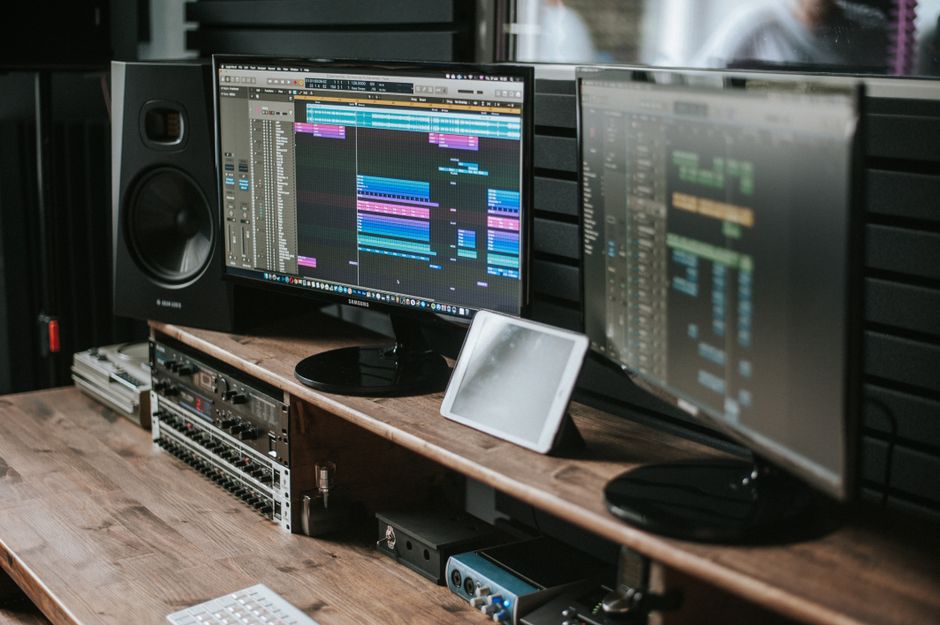
Nearfield Monitors: Acoustic Precision in Compact Spaces
The monitoring phase is a fundamental pillar in audio production, dictating the accuracy with which an engineer or producer makes critical mixing decisions. The choice between nearfield and midfield monitoring systems is not trivial; each offers distinct advantages that directly impact sonic perception and mix translation across various listening environments. This technical analysis examines the characteristics, applications, and key considerations of both approaches, providing an informed perspective for optimizing the studio environment and ensuring the reliability of contemporary productions, from home studios in Buenos Aires to complex professional facilities.
Nearfield monitors are designed to be listened to at short distances, typically between 1 and 1.5 meters. Their design prioritizes delivering sound directly to the listener, minimizing the influence of room acoustics. Characteristically, these systems employ smaller diameter drivers, contributing to a detailed stereo image and agile transient response. This configuration makes them particularly suitable for compact studio environments, where acoustic treatment may be limited or physical space restricts the placement of larger monitors. Producers and mixers worldwide often value their ability to reveal subtle nuances in a mix, from vocal articulation to the spatiality of effects. While their low-frequency extension may be less pronounced than that of larger systems, this limitation is compensated by clarity in the mid and high frequencies. Recent innovations, such as integrated digital signal processing (DSP) and room correction software like Sonarworks SoundID Reference (link), enable these monitors to offer a more linear frequency response tailored to the environment, elevating their performance in studios of various sizes. Models like Genelec’s 8000 series (link) or Neumann KH 120 (link) are representative examples of this category, widely used for their reliability.
Midfield Monitors: Expanded Perspective for Large-Scale Mixing
On the other hand, midfield monitors operate at greater listening distances, generally between 2 and 3 meters. These systems typically integrate larger drivers and more powerful amplification, allowing them to reproduce a wider frequency range, with deeper bass extension and higher Sound Pressure Level (SPL) capability. The primary advantage of midfield monitoring lies in its ability to offer a more faithful representation of how a mix will sound in larger listening environments, such as concert halls, clubs, or cinema sound systems. By involving greater interaction with room acoustics, these monitors require more extensive acoustic treatment and precise calibration to avoid unwanted coloration. They are the preferred choice for tasks demanding a more macro perspective of the mix, such as mastering, orchestral recording, or film audio post-production. Immersive music production, like Dolby Atmos mixes (link), often benefits from midfield or even mainfield systems, given the need for an expansive sound field and accurate translation to multiple speakers. Monitors like Focal Trio (link) or ADAM Audio S Series (link) exemplify the quality and performance expected in this category, providing an invaluable tool for critical decisions on overall balance and dynamics.
The selection of the monitoring system is only part of the equation; optimizing the studio’s acoustic environment is equally crucial. Adequate treatment with absorbers, diffusers, and bass traps is indispensable for mitigating unwanted reflections and resonances that can distort sonic perception, regardless of the monitor used. Correct monitor placement, following the equilateral triangle principle and adjusting height and angle, ensures a precise stereo image and a balanced frequency response at the listening position. Furthermore, modern room correction tools, such as Dirac Live or systems integrated into some monitors, represent a significant advancement by compensating for residual acoustic anomalies in the space. The practice of switching between nearfield and midfield monitors during the mixing process allows for verification of production translation, ensuring that fine details are maintained and the overall balance resonates correctly in different contexts. Current trends in music production, such as the proliferation of hybrid studios and the growing demand for mixes for streaming platforms with spatial audio, underscore the need for versatile and well-calibrated monitoring systems. Artificial intelligence also plays a role, with plugins that assist in spectral analysis and identification of balance issues, complementing human critical listening and refining sonic decision-making. This holistic approach, combining quality hardware, acoustic treatment, and advanced software, is fundamental to achieving consistent professional results.
Acoustic Optimization and Calibration: Keys to Sonic Reliability
In summary, both nearfield and midfield monitoring are essential tools in the arsenal of the music producer and audio engineer, each with a well-defined purpose. The appropriate choice depends on the studio dimensions, available budget, and, fundamentally, the specific production objectives. While nearfield monitors provide analytical precision in confined spaces, midfield monitors offer a larger-scale perspective and better translation capability to wide listening environments. Understanding their differences and the importance of an optimized acoustic environment is vital for any audio professional seeking to make reliable sonic decisions and achieve mixes that translate optimally on any playback system. The constant evolution of monitoring technology and room correction solutions promises to continue refining this critical phase of music production.
Related Posts

Biomimicry in Sound Creation: Principles, Capture, and Application in Modern Audio
Exploring biomimetic musical instruments, their recording techniques, and processing for contemporary audio workflows.

The Evolution of USB Audio Interfaces: Democratization and Technological Advancements in Music Production
USB redefined music production, from home studios to professionals, driving global accessibility and sound quality.

Sound Field Synthesis: Acoustic Principles, Implementation, and Immersive Applications
Advances in sound field synthesis, from Ambisonics and WFS to object-based audio, redefining music and audiovisual production.

Analog to Digital Transition in Music Signal Processing: Origins and Evolution of Effects
Historical and technical analysis of early digital effects, from delays to reverb, and their lasting impact on music production.