Acoustic Fundamentals for Home Studios: Absorption, Reflection, and Diffusion for Better Sound Quality
Optimize your music production environment. Understand sound's interaction with space for accurate recordings and mixes.

Acoustic Fundamentals: Absorption, Reflection, and Diffusion
The sound quality in any music production begins long before hitting ‘record’ or opening a plugin. The interaction of sound with the physical studio environment is a determining factor, often underestimated, especially in home setups. The space where audio is heard, recorded, and mixed directly impacts the fidelity and accuracy of what we perceive. Understanding the fundamentals of acoustics allows producers and musicians worldwide to transform a domestic environment into a reliable sound space, thereby optimizing creative and technical decisions. Adequate acoustic management is crucial for achieving transparent mixes and clear recordings, avoiding issues like unwanted resonances or phase cancellations that distort audio perception.
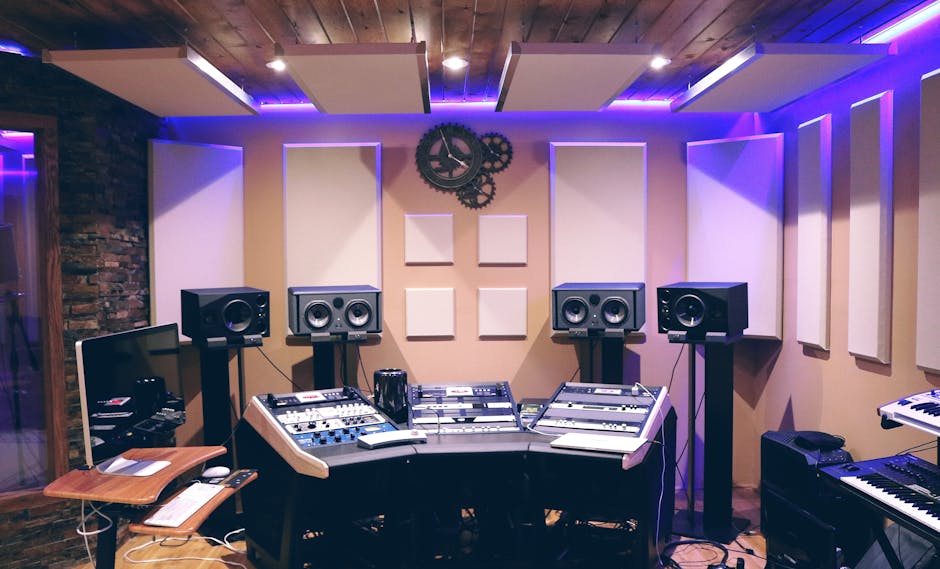
The acoustics of a room are governed by three primary phenomena: absorption, reflection, and diffusion. Absorption controls sound energy, reducing excessive reverberation and the sound’s decay time. Porous materials such as acoustic foam, mineral wool, or fiberglass panels are excellent absorbers. Reflection, on the other hand, occurs when sound bounces off hard surfaces, generating echoes and flutter echoes that muddy the signal. Identifying and mitigating first reflection points is fundamental for accurate monitoring. Finally, diffusion scatters sound waves in multiple directions, breaking up standing wave patterns and creating a more uniform and spacious sound field. Diffusers, often panels with complex geometries, are particularly useful at the rear of the room or at strategic points to prevent excessive absorption that can “kill” the sound. The balanced interaction of these elements defines a studio’s acoustic character.
Strategic Acoustic Treatment for Home Studios
Implementing effective acoustic treatment in a home studio doesn’t require an exorbitant investment but does demand a strategic approach. The first step involves identifying the first reflection points on the side walls, ceiling, and rear wall, using the mirror trick to locate them. At these points, installing absorbent panels at least 5-10 cm thick will result in a significant improvement. Bass traps are indispensable for controlling low frequencies, which tend to accumulate in room corners, generating problematic resonances. Placing bass traps in the room’s corners is a highly effective measure. For diffusion, QRD (Quadratic Residue Diffuser) panels or even irregular bookshelves with books can provide beneficial sound dispersion. It’s important to consider the symmetry of the treatment relative to the listening position to maintain accurate stereo balance. The choice of materials and their density directly influence the frequency range they can absorb or diffuse. Companies like GIK Acoustics or Auralex offer modular solutions that facilitate this task for smaller studios.
Subjective perception is important, but objective measurement provides crucial data. Acoustic analysis tools like REW (Room EQ Wizard) or Sonarworks SoundID Reference allow users to obtain an accurate reading of their room’s frequency response and reverberation time (RT60). With a calibrated measurement microphone, these programs identify peaks and dips in the frequency spectrum, as well as the presence of resonant modes. This information is invaluable for adjusting existing acoustic treatment or planning new additions. For instance, if the data reveals an energy buildup at 80 Hz, one might consider adding denser bass traps or adjusting their placement. Optimization doesn’t end with panel installation; the positioning of monitors and the listening station is also critical. The equilateral triangle rule for monitors and listening is a good starting point, adjusting distances from walls to minimize negative interaction. Integrating DSP (Digital Signal Processing) based room correction systems like Sonarworks or Dirac Live represents a current trend that complements, but does not replace, physical acoustic treatment, refining the system’s final response.
Objective Measurement and Sound Space Optimization
The field of acoustics and music production is constantly evolving, with technological advancements complementing traditional practices. Artificial intelligence (AI) is beginning to influence room correction, offering more sophisticated algorithms to adapt monitor response to the environment. Platforms like Sonarworks’ SoundID Reference, for example, use measurements to create correction profiles that are applied digitally, improving the linearity of the frequency response at the listening position. Furthermore, with the rise of immersive audio formats like Dolby Atmos, understanding three-dimensional acoustics becomes even more relevant. Although a home studio may not have a full Atmos setup, applying acoustic principles to optimize stereo or binaural monitoring helps prepare the space for future expansions or for producing content that will translate well to these new formats. Remote and collaborative production also underscores the need for reliable listening environments, as decisions made in one studio must be consistent with the perceptions of other collaborators. Secure remote monitoring tools, such as Audiomovers Listento, greatly benefit from a transparent and acoustically controlled initial audio chain. Knowledge of these fundamentals allows producers worldwide to stay at the forefront, adapting to innovations without losing sight of the physical basis of sound.
Investing in studio acoustics is, in essence, an investment in the accuracy of musical decisions. By understanding and applying the principles of absorption, reflection, and diffusion, along with measurement tools and the latest technological trends, any producer can transform a domestic space into a professional production environment. This not only improves the quality of recordings and mixes but also fosters a more efficient creative process and more consistent, competitive sound results. Continuous improvement of the acoustic environment is a fundamental pillar for any modern studio.
Related Posts
Pro Tools: Technological Evolution and Standard in Digital Audio Production
An analysis of Pro Tools' journey, from its DSP beginnings to native production and immersive audio.

DAW Automation: Operational Principles, Creative Applications, and Future Trends
Analysis of automation in DAWs: recording, drawing, advanced effects, AI, and immersive audio for music production.

Generative Sound Design: Algorithmic Architecture for Dynamic Soundscapes
Explore the creation of evolving musical textures and ambiences using algorithms and autonomous systems in modern production.

Almendra: Harmonic and Poetic Innovation in Argentine Rock
Analysis of Almendra's sonic and lyrical proposal, pioneers of Argentine rock and their impact on Latin American music.