Home Studio Optimization: Professional Sound Quality on a Limited Budget in Latin America
Equipment and acoustic strategies for a high-fidelity home studio without excessive investment, prioritizing informed decisions.

Monitoring and Acoustic Fundamentals for Budget Home Studios
The creation of a personal recording studio, or “home studio,” is a common aspiration among musicians and producers in Argentina and throughout Latin America. However, the perception that it requires an exorbitant investment can be a deterrent. This analysis addresses the efficient setup of a music production space with limited financial resources, emphasizing that sound quality is more a result of informed decisions and optimization than the magnitude of the expenditure. The goal is to demystify the notion that a modest budget compromises auditory excellence, presenting strategies and equipment that allow for professional results through rigorous selection and the application of technical knowledge.
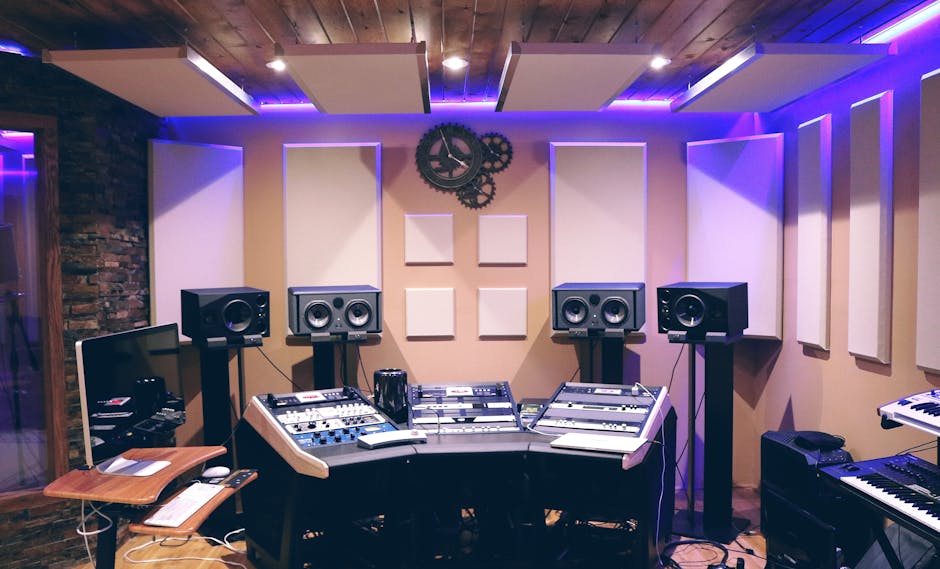
The initial investment in a home studio demands strategic prioritization, where monitoring and room acoustics are determining factors. A robust audio chain begins with faithful listening. For this, nearfield monitors with a flat frequency response are essential. Brands like JBL, KRK, or Behringer offer accessible models that provide a solid foundation for mixing. Complementing this with reference studio headphones, such as the Audio-Technica ATH-M20x or Sennheiser HD 206, allows for an additional perspective and verification of fine details, crucial in acoustically untreated environments. Regarding sound treatment, massive investment is not indispensable. Absorbent acoustic panels, diffusers, and bass traps can be crafted affordably with materials like rock wool or fiberglass, or purchased in basic kits. Strategic placement of these elements, along with the optimal arrangement of monitors to form an equilateral triangle with the listener, significantly impacts audio perception. Room response analysis tools, some free or included in DAWs, help identify resonant issues and optimize furniture placement, a step prior to considering more advanced room correction solutions like SoundID Reference by Sonarworks. While it has a cost, it can be a later investment that drastically improves accuracy.
Strategic Selection of Versatile Interfaces and Microphones
The signal’s entry point, the audio interface, is another vital component. A unit with clean preamps and low latency is essential for transparent recording. Models like the Focusrite Scarlett 2i2, the Behringer UMC202HD, or the Presonus AudioBox USB 96 offer excellent value for money, providing at least two inputs for microphones and instruments, sufficient for most home productions. Microphone selection requires versatility. A general-purpose dynamic microphone, such as the Shure SM57 or SM58, is indispensable due to its robustness and ability to capture vocals, guitars, and percussion. For vocal recordings or acoustic instruments demanding greater detail, a large-diaphragm condenser microphone, like the Audio-Technica AT2020 or the Rode NT1, represents a substantial improvement without incurring excessive costs. USB-C technology in recent interfaces facilitates connectivity and improves data transfer stability, a trend observed in entry-level equipment.
In the digital realm, software presents itself as a powerful ally for the budget-conscious producer. The Digital Audio Workstation (DAW) is the studio’s brain. Software options like Cakewalk by BandLab (free for Windows), GarageBand (free for macOS), or Reaper (with a very accessible license) provide complete professional functionalities. Audacity, while more limited, serves for basic editing and recording tasks. The library of free plugins is vast and high-quality. Exceptional reverbs can be obtained from Valhalla DSP (like Valhalla Supermassive), transparent compressors like the “RoughRider” from Audio Damage, or precise equalizers from TDR Nova. Free virtual instruments, such as those from Native Instruments Komplete Start or Korg M1 Le, considerably expand the sonic palette. Artificial intelligence (AI) is also beginning to influence this segment, with tools that assist in mixing or mastering tasks, some available in “lite” or trial versions that allow experimentation with their capabilities. Online collaborative platforms like BandLab or Soundtrap facilitate remote production, reflecting a growing trend in the global music industry, enabling artists from different geographical locations to contribute to the same project.
Free Software and Plugins: Empowering Digital Production
In summary, setting up a functional home studio capable of generating high-fidelity productions is not limited by economic capacity. The key lies in meticulous planning, identifying the essential components that directly impact sound quality, and intelligently utilizing available resources. Prioritizing accurate listening through adequate monitoring and basic acoustic treatment, selecting interfaces and microphones with optimal price-performance ratio, and leveraging the vast universe of free or low-cost software and plugins are the pillars of this strategy. Technological evolution, with the emergence of AI solutions and collaborative platforms, continues to expand possibilities for creators, demonstrating that innovation and creativity can thrive even with modest initial capital. A well-thought-out and optimized studio is, ultimately, the most powerful tool for artistic development.
Related Posts
Fundamentals of Audio Monitoring: Components, Acoustics, and Calibration for Professional Production
Technical analysis of monitoring systems, room acoustics, and calibration for achieving sonic accuracy in music productions.

Creative Sampling: Evolution, Sound Transformation Techniques, and AI-Assisted Synthesis
Exploring the integration of sampling in music production, from field recording to AI and its artistic implications.

Fundamentals of Synthesis and Spatial Processing in Contemporary Ambient Music Production
Analysis of synthesis, spatial processing, and composition techniques for creating immersive soundscapes in ambient music.

The Evolution of Chorus and Flanger: From Tape to Digital Algorithms in Sound Design
An analysis of the trajectory and application of chorus and flanger effects, from their manual origins to contemporary digital innovations.