Augmented Reality in Instrumental Recording: Visualization, Simulation, and Remote Collaboration
Analyzes how AR redefines music production, enabling parameter visualization, acoustic environment simulation, and global collaboration.

Hardware and Software Foundations for AR in Recording
The integration of augmented reality (AR) into music production represents a technological frontier with significant implications for instrumental recording. This convergence of the physical and digital redefines the musician’s interaction with their creative environment, offering new dimensions for capturing and manipulating sound. This analysis addresses how AR is beginning to reconfigure recording studios, allowing artists and producers to transcend traditional spatial and visual limitations to model unprecedented auditory experiences. The potential of AR to enhance instrumental expressiveness and optimize workflows is examined, positioning it as a vector of innovation in the industry.
The implementation of augmented reality in instrumental recording is based on a synergy of specialized hardware and software. Visualization devices, such as AR glasses or headsets, project contextual information onto the user’s physical environment, overlaying graphics and real-time data. These systems are complemented by motion and spatial tracking sensors that record the position and orientation of instruments and the performer’s hands. On the software side, AR development kits (SDKs) enable programmers to create applications that integrate advanced audio engines. Specific plugins, adapted for AR environments, can visualize effect parameters, dynamic envelopes, or even the resonance of a virtual space within the musician’s field of view. For example, a guitarist could observe in their visor how their amplifier’s signal interacts with a 3D model of a concert hall, adjusting virtual microphones with intuitive gestures. The ability to observe visual representations of sound, such as floating spectrograms or dynamic level meters, provides instant feedback that was previously only possible via external screens, freeing the engineer and musician to interact more directly with the creative process. Low latency is a critical requirement, and advances in edge processing and high-speed networks are fundamental to ensuring a fluid and responsive experience.
Immersive AR Applications in Sound Production
The applications of augmented reality in instrumental recording are varied and promise to transform multiple facets of sound production. One of the most notable uses is the immersive visualization of mix and effect parameters. A producer can project a three-dimensional virtual mixer into their studio, manipulating faders, EQ knobs, or reverb controls using gestures in the air, without needing to interact with a physical surface. This not only simplifies the interface but also allows for a more organic and spatial interaction with sound.
Another significant area lies in the creation of simulated acoustic environments. A musician could record an instrument in a dry studio, while an AR system overlays the acoustics of a gothic cathedral or a jazz club, allowing the performer to adapt their playing to these virtual conditions in real-time. This technique optimizes post-production flexibility and opens new avenues for sonic experimentation.
Remote collaboration also benefits enormously. Multiple musicians and producers, located in different geographies, could share the same augmented virtual recording environment, seeing and hearing instrumental interactions as if they were in the same room. This aligns with current trends in distributed production and the rise of platforms like SoundCloud or Bandcamp that facilitate global collaboration. Companies like Spatial (though more focused on meetings, the concept of shared space is relevant) and studios experimenting with Dolby Atmos are paving the way for immersive auditory experiences that AR can visually complement. Furthermore, AR can facilitate instrumental learning, projecting interactive sheet music or fingering guides directly onto the instrument or the student’s hands.
Despite its potential, the full integration of augmented reality into recording studios faces several technical challenges. Latency, as previously mentioned, is a crucial obstacle; any perceptible delay between the musician’s action and the AR system’s response can compromise the fluidity of the performance. The processing power required to render complex graphics and manipulate audio in real-time demands high-performance hardware, which can involve considerable costs. The ergonomics of AR devices are also a factor; bulky or uncomfortable headsets could interfere with the musician’s concentration during extended sessions.
However, the future prospects are promising. Miniaturization of components, increased energy efficiency, and improvements in device resolution and field of view are anticipated. Artificial intelligence (AI) will play a prominent role, with algorithms capable of predicting the musician’s intentions, dynamically adapting effects, or even generating complementary instrumental parts in real-time within the augmented environment. The standardization of protocols and interoperability between different AR platforms and DAWs (like Ableton Live or Pro Tools) will be key to its mass adoption. The evolution towards more intuitive interfaces, perhaps based on brainwave reading or eye tracking, could completely redefine human-machine interaction in music production, taking creativity to previously unattainable spheres.
Technical Challenges and Future Prospects of Musical AR
Augmented reality is emerging as a transformative tool for instrumental recording, merging physical performance with an interactive digital canvas. Its ability to visualize sound, simulate acoustic environments, and foster remote collaboration redefines the boundaries of music production. While technical challenges related to latency and hardware persist, the trajectory of technological innovation suggests a future where AR will be an integral and accessible component in any producer’s or musician’s arsenal, opening doors to unprecedented artistic expressions and operational efficiencies in the industry.
Related Posts

Shangri-La: Acoustics, Analog Gear, and the Persistence of Organic Sound Philosophy
Analyzing Shangri-La's legacy: the fusion of isolation, exceptional acoustics, and analog equipment in modern music production.
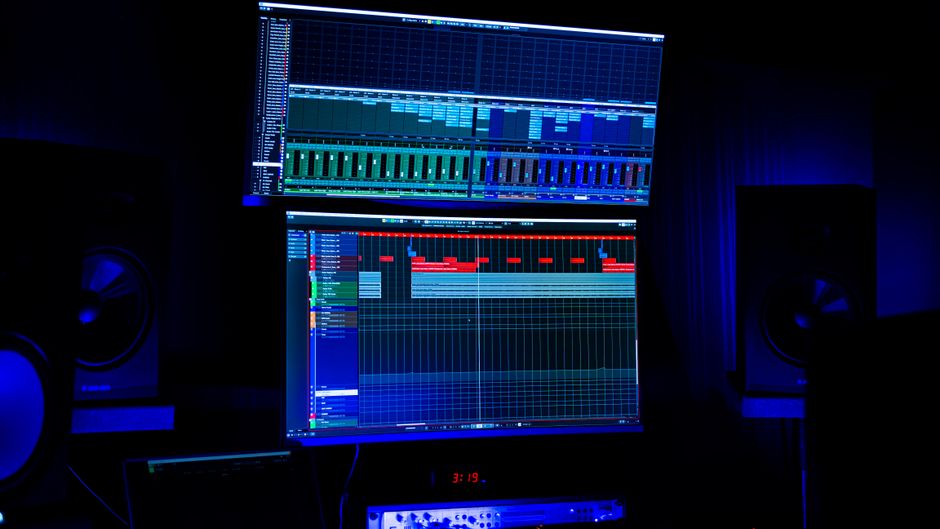
Studio One 6: Unified Architecture and Workflow for Modern Music Production
Analysis of Studio One's single interface, mix/mastering tools, and ARA2 support, optimizing sound creation.

Reason: Evolution from Virtual Studio to Full DAW and Modular Plugin
Analysis of Reason's development, from its virtual rack to plugin and DAW integration, highlighting its constant innovation.

Power Station NYC: Acoustic Design and Technological Evolution in Audio Engineering
Exploring Power Station's acoustic legacy and its adaptation to modern music production, from analog to AI.