Drum Machines: Technological Evolution, Impact on Music Genres, and Sonic Legacy
A journey through the history of drum machines, from their beginnings to the digital age, and their influence on modern music.
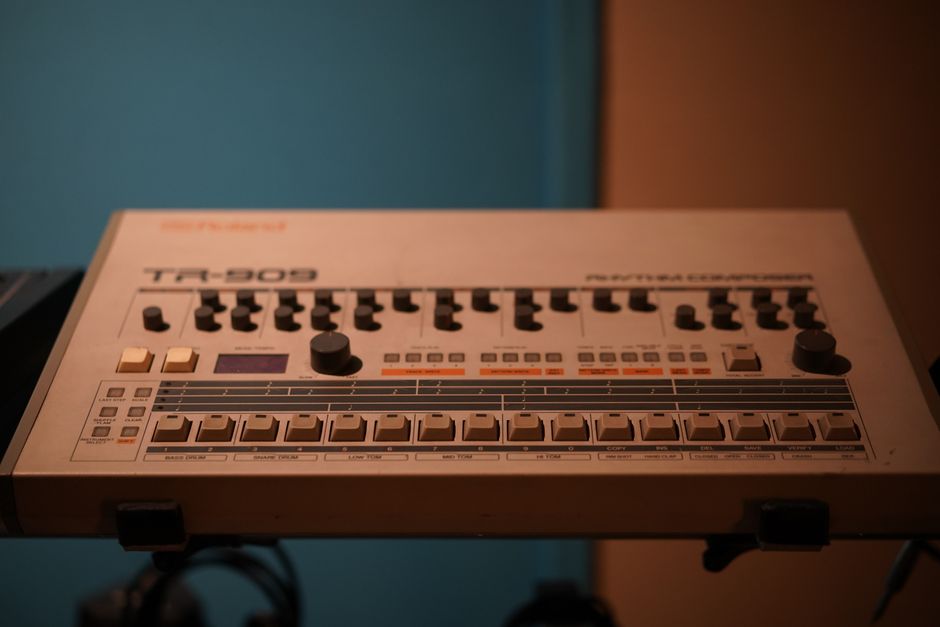
Origins of Rhythmic Automation: Early Devices
Percussion, the fundamental bedrock of human musical expression, has been the subject of constant technological innovation. From the earliest attempts to automate rhythmic patterns to today’s sophisticated sequencers, the evolution of drum machines has radically transformed sound creation and production. This analysis reviews the trajectory of these devices, key elements in shaping contemporary musical genres.
The Dawn of Rhythmic Automation
The first devices conceived to generate rhythms autonomously emerged in the mid-20th century. Léon Theremin’s Rhythmicon, developed in the 1930s, represented a pioneering effort in creating complex polyrhythms using spinning optical discs. However, its complexity limited its reach. Later, in 1959, the Wurlitzer Sideman positioned itself as the first commercial drum machine, incorporating electromechanical sounds produced by vacuum tubes and a rotating motor. This instrument offered preset patterns of bass drum, snare, cymbals, and cowbell, providing rudimentary accompaniment for organs and guitars. Its mechanical structure and static sounds laid the groundwork for future electronic implementations, demonstrating the viability of automated percussion in musical contexts.
The Electronic Transition and Sequential Programming
Electronic Evolution and Digital Sampling in Drum Machines
The 1960s witnessed the emergence of entirely electronic designs, led by Japanese companies like Ace Tone, with its Rhythm Ace FR-1. These models improved reliability and reduced size, although they still primarily offered predefined rhythms. The true turning point occurred with the introduction of the Roland CR-78 in 1978, the first microprocessor-based drum machine that allowed users to store their own rhythmic patterns, marking a milestone in interactivity.
Nevertheless, the iconic Roland TR-808, launched in 1980, completely redefined the landscape. Despite not realistically emulating acoustic drum sounds, its distinctive analog timbres – a deep kick drum, a snappy snare, and a piercing cowbell – gave it an unmistakable sonic identity. Its step sequencer facilitated the composition of complex rhythms, making it an essential tool for genres like hip-hop, techno, and electronic pop. Its legacy endures, with hardware replicas and software emulations widely used today. To delve deeper into its impact, you can consult the history of the TR-808 on the official Roland site.
In parallel, the Linn LM-1 Drum Computer, introduced in 1980 by Roger Linn, brought a transcendental innovation: the use of digital audio samples to generate percussion sounds. This advancement offered more realistic sound quality and unprecedented flexibility, attracting high-profile producers and consolidating the concept of sample-based drum machines. The LinnDrum, its 1982 successor, expanded these capabilities, setting a standard for music production of the era. A detailed analysis of the LinnDrum can be found in Sound on Sound.
Cultural Impact and Continuous Evolution
Sociocultural Impact and Contemporary Trends in Electronic Percussion
The influence of drum machines spread rapidly, democratizing music production by offering artists and producers a complete rhythm section without the need for session musicians. Their presence became ubiquitous in popular music of the 80s and 90s, from synth-pop to R&B and house. Models like the Akai MPC Series, launched in 1988, integrated sequencers, samplers, and velocity-sensitive pads, transforming into complete workstations and fundamental tools for beat creation in hip-hop. The evolution of the MPC series can be reviewed on the Akai Pro site.
Today, the drum machine ecosystem is diverse. Modern hardware versions, such as Elektron devices or the new iterations of Roland’s TR series (TR-8S, TR-6S), coexist with sophisticated software solutions. Plugins like Ableton Live’s Drum Rack, which can be explored on the Ableton site, or Native Instruments Maschine instruments, available at Native Instruments, offer advanced rhythmic programming capabilities, integrating synthesis, sampling, and effects. Artificial intelligence is also beginning to play a role in generating rhythmic patterns, offering new creative perspectives and optimizing studio workflows.
The persistent interest in classic sounds, combined with continuous innovation in interfaces and algorithms, ensures that drum machines remain a cornerstone in contemporary music production. Their trajectory illustrates a fascinating technological journey that has shaped countless sonic landscapes around the globe, from studios in Buenos Aires to the epicenters of global electronic music.
Related Posts
Trueno's Sonic Evolution: From Freestyle Battles to Global Sound Architect
Explore the dynamic sonic journey of Argentinian artist Trueno, tracing his evolution from raw freestyle to a polished global soundscape and influential musical production.

Blackbird Studios: Advanced Acoustics and Equipment Heritage in Contemporary Audio Engineering
Innovation in acoustics and analog/digital technology at Blackbird Studios, a global benchmark for sound quality.

Ableton Live: Evolving Software-Hardware Interaction in Modern Music Production
An evolutionary analysis of Ableton Live software, its impact on composition, performance, and hardware-software integration.
Spatial Audio Mastering: Dynamic Processing and Technical Verification in Immersive Environments
Technical analysis of multichannel workflows, dynamic processing, and verification strategies for spatial audio productions.