The Historical Evolution of Sequencers: From Mechanisms to AI in Music Composition
Trace the innovation in sequencers, from mechanical precursors to AI tools, redefining music production.
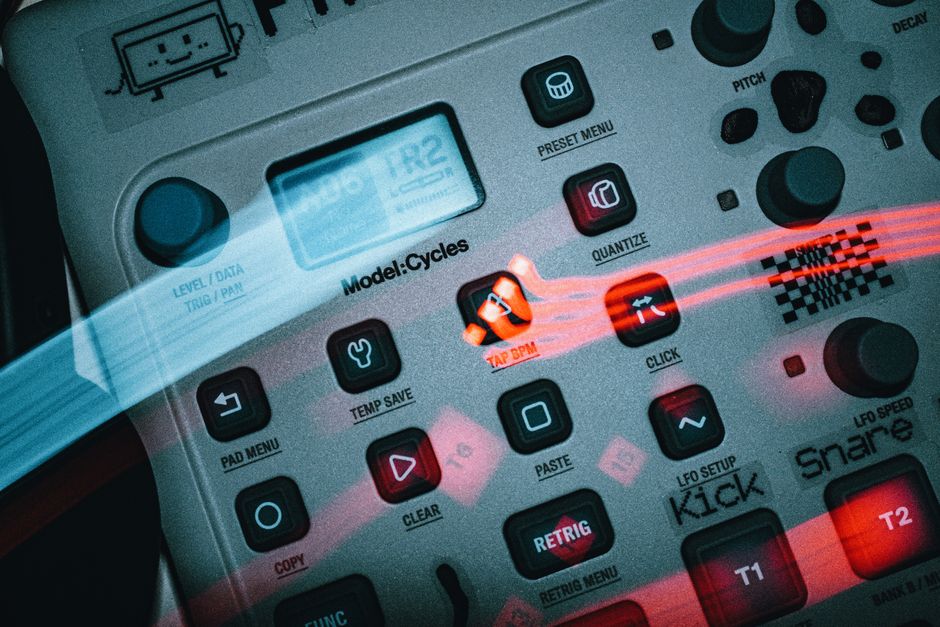
Mechanical and Electronic Origins of Musical Sequencing
Contemporary music creation fundamentally relies on the ability to orchestrate sonic events over time. This process, known as sequencing, allows artists and producers to structure complex compositions with precision. Studying the genesis of sequencers reveals a fascinating trajectory from rudimentary mechanisms to today’s sophisticated digital tools, radically transforming music production.
The precursors to electronic sequencing are found in mechanical devices such as player pianos with perforated rolls and music boxes. These contraptions, using physical patterns, reproduced predefined musical sequences. However, the true revolution began with electronics. In the mid-20th century, systems like the RCA Mark II synthesizer, a marvel of engineering for its time, employed punched cards to program sounds and sequences. This method, though primitive, laid the groundwork for the automated control of musical parameters. With the advent of modular synthesizers in the 1960s, manufacturers like Moog and Buchla introduced voltage-based sequencing modules. These allowed for the storage and playback of control signal series that modulated pitch, filter, and other sonic characteristics, offering composers a new way to generate repetitive or evolving rhythmic and melodic textures.
The MIDI Revolution: Interconnection and Instrument Control
The 1980s marked a milestone with the standardization of the Musical Instrument Digital Interface (MIDI). This communication protocol, which links electronic instruments, synthesizers, computers, and other devices, represented a crucial advancement. MIDI does not transmit audio, but rather control data regarding notes, velocity, duration, and other parameters, enabling a single sequencer to control multiple instruments simultaneously. The implementation of MIDI facilitated unprecedented interconnection in recording studios, significantly expanding the possibilities for arrangement and composition. Devices like the Roland MC-4 and, later, the Akai MPC series, set the standard for hardware sequencing, offering tactile interfaces for programming rhythms and melodies with an immediacy that remains valued today.
The development of personal computers in the last decades of the 20th century propelled the evolution of sequencers into software environments. Digital Audio Workstations (DAWs) such as Cubase, Logic Pro, and Ableton Live integrated sequencing capabilities with audio editing, mixing, and effects processing within a single environment. This transition virtualized the studio, offering unparalleled flexibility for non-linear editing, detailed manipulation of MIDI events, and complex synchronization of multiple tracks. Music production became more accessible and versatile, allowing artists to work with greater efficiency and precision in the conception and realization of their works.
Evolution to Software Environments: DAWs and Virtual Production
Currently, sequencing continues to innovate with the integration of artificial intelligence and generative algorithms. Tools like AI-assisted composition plugins or modular software environments such as VCV Rack and Max/MSP allow producers to explore new creative frontiers, generating rhythmic and melodic patterns that adapt dynamically or are based on complex parameters. Furthermore, the trend towards immersive audio, such as Dolby Atmos, and collaborative online production highlights the need for sequencers that handle not only MIDI and audio data, but also spatial information and advanced automation. The ability to program and manipulate musical time remains at the heart of production, now enriched by cloud computing and real-time interaction. The evolution of sequencers, from simple mechanisms to complex algorithms, reflects a constant pursuit of new forms of musical expression.
In summary, the trajectory of sequencers represents a chronicle of technological innovation in service of creativity. From punched cards and control voltages to AI-driven software environments, these devices have redefined how music is constructed and experienced. Their impact persists, shaping the sonic landscape of contemporary productions and pointing towards future explorations in composition and sound design.
Related Posts

Adaptive Acoustics and Live Recording: The Defining Sound of Stax Records
An analysis of Stax Records' sonic methodology, unique acoustics, and live recording techniques that defined a genre.

Ableton Live: Evolving Software-Hardware Interaction in Modern Music Production
An evolutionary analysis of Ableton Live software, its impact on composition, performance, and hardware-software integration.

Harrison Mixbus: Analog Console Emulation and Digital Workflow for Audio Engineers
An analysis of the Harrison Mixbus mixing engine, its processing architecture, and practical applications in modern music production.

VCA vs. Optical Compressors: Mechanisms, Applications, and Sonic Cohesion in Music Production
Analyzes the technical and sonic differences between VCA and optical compressors for optimizing dynamics in mixes.