Temporal Granular Synthesis: Parameters, Methodologies, and Applications in Contemporary Sound Design
A deep dive into granular synthesis, its core components, and its innovative use in crafting sonic textures and landscapes.

Fundamentals of Temporal Granular Synthesis
Temporal granular synthesis stands as one of the most versatile and profound methodologies in modern sound design. This audio generation paradigm fragments any sound sample or waveform into microscopic “grains,” which are then re-arranged, manipulated, and played back to construct new textures, soundscapes, and rhythms. Its ability to deconstruct sound down to its most elemental components allows for unprecedented manipulation, paving the way for timbre creation that transcends traditional synthesis methods. Musicians and producers worldwide, from Buenos Aires to Berlin, employ this technique to inject originality and complexity into their work, spanning experimental music to more structured genres like techno and ambient.
Essential Components and Parameters in Granulation
The core of granular synthesis lies in the “grain,” an extremely brief unit of sound, typically ranging from 1 to 100 milliseconds in duration. Each grain possesses independent attributes that can be modulated:
- Duration: The length of time a grain remains audible. Variations in this parameter can transform a continuous sound into a series of clicks or into a smooth, diffuse texture.
- Envelope: Defines the grain’s attack, decay, sustain, and release shape. A soft envelope prevents audible artifacts at the beginning and end of each grain.
- Pitch: The tonal height of the grain. Individual adjustments allow for the generation of chords, clusters, or pitch-dispersion effects.
- Start Position: The point within the original sample from which the grain is extracted. Randomizing or sequencing this parameter produces dynamic and evolving results.
- Density: The number of grains played back per second. High density generates dense, continuous textures, while low density produces more spaced-out, rhythmic patterns.
- Spread: Determines the randomness in the distribution of grains across time and stereo space. This contributes to the richness and spatial width of the sound.
The manipulation of these parameters, often in real-time and with complex modulators, allows for the construction of a vast sonic spectrum. From ethereal drones and evolving pads to glitchy rhythmic effects and noisy textures, granularity offers an expansive sonic canvas.
Key Parameters and Grain Modulation
Advanced Methodologies and Creative Sound Design
One of the most potent applications is the generation of “granular clouds,” where thousands of grains overlap with random variations in their parameters. This method is ideal for creating immersive soundscapes or transforming field recordings into abstract environments. Tools like Output’s Portal plugin, or granular synthesis modules in environments such as Max/MSP or Pure Data, facilitate this exploration.
Live granular synthesis, often using MIDI controllers with MPE (Multidimensional Polyphonic Expression) capabilities, offers unprecedented tactile interaction. A performer can simultaneously manipulate the duration, pitch, and density of grains with finger pressure and movement, generating organic expressiveness. This real-time interaction is particularly relevant in genres that value improvisation and sonic evolution, such as experimental music and live electronic performance.
Recent innovations incorporate artificial intelligence to automate grain selection or the generation of parametric sequences, streamlining the creative process and offering unexpected results. Some plugins employ neural networks to analyze an audio sample and suggest granular configurations that maintain certain tonal or rhythmic characteristics, a significant advancement for producers seeking efficiency and novelty.
Advanced Applications and Creative Sound Design
Optimization and Workflows in Contemporary Studios
The integration of granular synthesis into a modern DAW is seamless. Many software synthesizers and advanced samplers include granular modules, such as Granulator II in Ableton Live or Native Instruments’ various Reaktor instruments. For deeper control, virtual modular environments like VCV Rack or scripting capabilities in programs like Bitwig Studio provide a flexible framework for designing custom granular instruments.
A crucial aspect in the studio is resource management. Although granularity can be CPU-intensive, software optimizations and efficient use of computer architecture allow for multiple instances to run. Strategies like rendering complex granular textures to audio (bounce in place) or using offline processing are common practices to maintain system efficiency.
In the context of remote and collaborative production, granular synthesis offers a unique way to share and manipulate sounds. A producer in Buenos Aires can send a sample to an external collaborator, who then transforms it granularly and returns a completely new texture, facilitating dynamic and geographically diverse creative interaction. Platforms like Splice or Loopcloud, while not specific to granularity, are examples of ecosystems where these transformed sounds can be shared.
Integration into Modern Studio Workflows
Temporal grain synthesis constitutes a fundamental tool for avant-garde sound design. Its methodology, based on the deconstruction and recombination of sonic fragments, provides musicians and producers with immense creative freedom to sculpt complex and original auditory landscapes. From modulating basic parameters to implementing granular clouds and live interaction with MPE controllers, this technique continues to evolve, driven by software advancements and the integration of artificial intelligence. Understanding and applying these fundamentals opens a universe of possibilities for contemporary music creation, allowing for the forging of sonorities that challenge conventions and expand the boundaries of auditory expression.
Related Posts

The Historical Evolution of Drum Machines: From Mechanical to AI in Music Production
We analyze the technological journey of drum machines, from their origins to AI innovations and their sonic impact.

Oberheim: Sonic Architecture and Legacy in Analog Polyphonic Synthesis
Exploring modular design, pioneering polyphony, and the enduring influence of Oberheim synthesizers on electronic music.
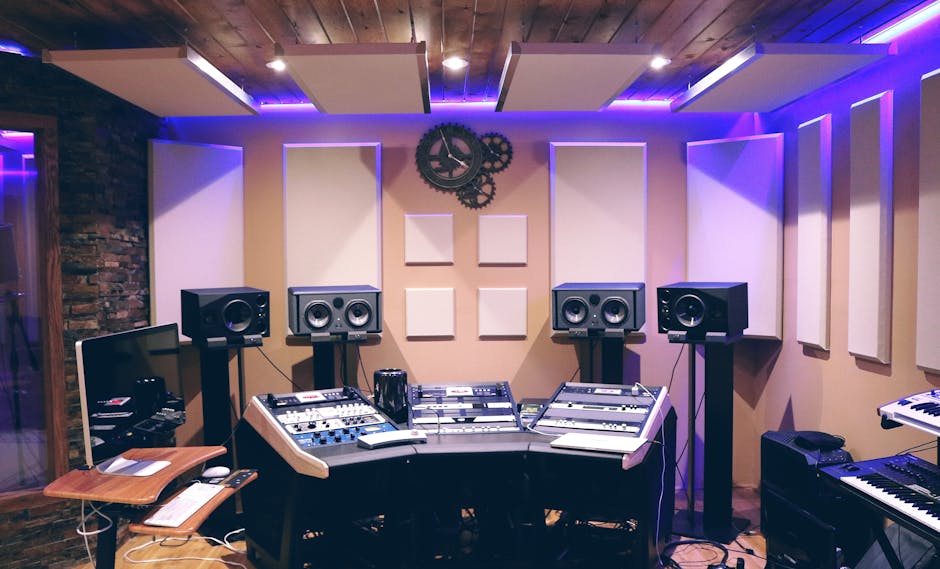
Studio Monitoring Fundamentals: Components, Acoustics, and Calibration for Sonic Fidelity
Technical analysis of speakers, interfaces, acoustic treatment, and calibration for precise audio reproduction in professional environments.

Granular Synthesis: Microtemporal Sound Deconstruction and Reconstruction
Explore granular synthesis: microscopic audio manipulation for complex textures and innovative soundscapes.