Minor Percussion Recording: Acoustics, Microphones, and Processing for Studio Sound Quality
Fundamentals of recording and mixing minor percussion, from instrument selection to advanced processing techniques.
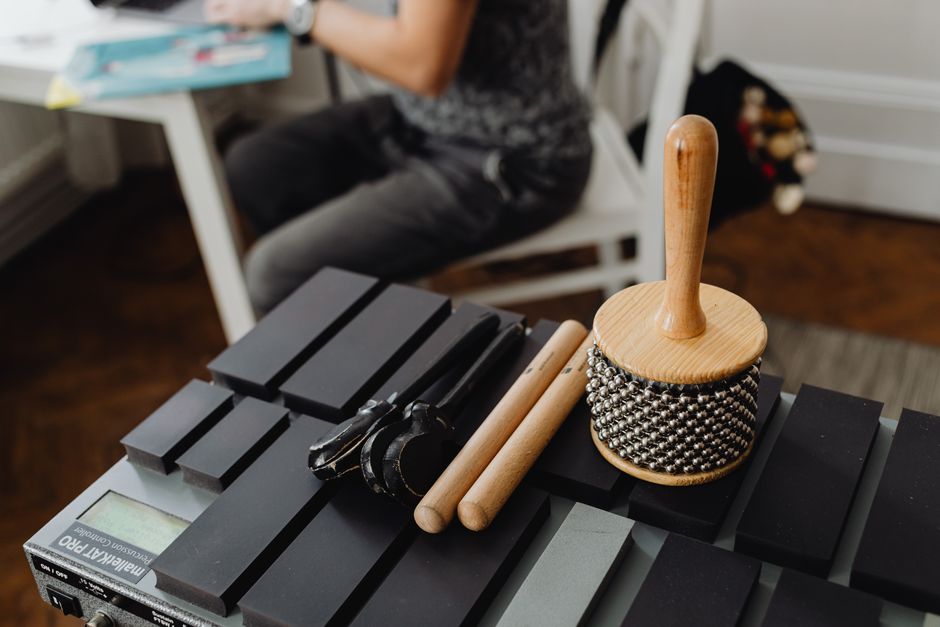
Instrument Selection and Preparation for Minor Percussion
The incorporation of minor percussion instruments into a musical production often defines the character and rhythmic depth of a piece. From the subtle shimmer of a shaker to the resonant hit of a cajón, these elements add essential texture and movement. Capturing them correctly in the studio is fundamental to preserving their distinctive sonic quality and ensuring their proper integration into the final mix. Meticulous attention to detail during the recording process makes a significant difference, elevating the overall quality of the work.
The choice of the right instrument is the critical first step. The intrinsic quality of a maraca, pandeiro, or guiro directly impacts the final outcome. It is recommended to inspect each item to ensure it is in optimal condition, free from unwanted resonances or structural defects. Tuning, where applicable, is a determining factor; an out-of-tune triangle or a cowbell with harsh overtones can compromise the tonal coherence of the composition.
Subsequently, the acoustic preparation of the recording space is unavoidable. Although minor percussion does not generate the same volume as a full drum kit, its fast transients and broad frequency spectrum require a controlled environment. A studio with excessive reflections will produce a “boxy” or “muddy” sound, while a space that is too dry will lack life. The implementation of absorption panels and diffusers can mitigate acoustic problems, allowing the microphone to capture the direct sound of the instrument with minimal ambient coloration. Experimenting with the instrument’s distance from reflective surfaces can also modify the perception of the space’s natural reverberation.
Acoustic and Recording Environment Considerations
Microphone selection and placement are crucial for capturing minor percussion. Small-diaphragm condenser microphones are frequently optimal due to their precise transient response and wide frequency range, ideal for capturing the finest details of a shaker or claves. For instruments with more body or that require greater impact, such as a cajón or tambourine, a dynamic microphone or even a large-diaphragm condenser might be more appropriate. Ribbon microphones, with their smooth high-frequency response, can offer a particular warmth to certain percussive elements.
Placement varies considerably depending on the instrument. For a shaker or maracas, a single microphone at a distance of 15-30 cm, aimed slightly towards the center of the movement, usually works well. In the case of a tambourine, one can opt for a microphone at close range, focused on the head or the jingles, depending on the desired emphasis. For surface instruments like the cajón, two microphones can be employed: one on the front to capture the strike and another on the rear port for sub-bass frequencies, paying attention to the phase relationship between them. Stereo techniques (XY, ORTF) can provide an immersive spatial image for percussion ensembles, generating a sense of width. It is crucial to verify phase coherence between microphones, especially when using multiple configurations, to avoid unwanted cancellations that thin out the sound.
Once the signal is captured, processing is the next stage. The pre-amplification stage is vital; a high-quality preamplifier ensures a clean and robust signal, preserving the instrument’s dynamics and timbre. Adjusting the gain appropriately is fundamental to avoid clipping and maintain optimal dynamic range.
Miking and Positioning Techniques for Percussion
In the mixing phase, equalization (EQ) allows for sculpting the tone of minor percussion. Annoying resonant frequencies can be attenuated, or the necessary brightness can be enhanced for the instrument to stand out in the mix. For example, slightly boosting the high frequencies of a shaker can increase its presence, while cutting excessive lows on a tambourine prevents it from muddying the rhythm section. Compression is a powerful tool for controlling dynamics. Subtle compression can unify the sound of a tambourine, while more aggressive compression can add “punch” to a cajón. It is important to apply compression consciously to avoid eliminating the performer’s natural expressiveness.
Time-based effects, such as reverb and delay, can enrich spatial perception. A short, dense reverb can provide ambiance to a dry instrument, while a rhythmic delay can create interesting patterns. Volume and panning automation also contribute to the liveliness of percussion, giving it movement and a defined place in the stereo field. Modern plugins, such as transient designers, allow for precise modification of the attack and sustain of percussive sounds, offering detailed control over their impact.
The current landscape of music production constantly integrates new tools and methodologies for minor percussion. Artificial intelligence (AI) is beginning to offer solutions for noise reduction or transient enhancement in complex recordings. Remote collaboration platforms, such as Soundtrap or Splice Studio, allow musicians from different locations to contribute their minor percussion recordings to a common project, facilitating cultural and technical diversity.
Processing and Mixing of Percussive Signals
Virtual instruments have achieved astonishing realism, with detailed sample libraries that replicate the richness of acoustic percussion. Plugins like Native Instruments’ Kontakt offer a vast range of customizable sounds. Production in immersive audio formats, such as Dolby Atmos, also drives new considerations for percussion. Placing a shaker in three-dimensional space can create an enveloping auditory experience, different from traditional stereo mixing. Contemporary music producers frequently use these techniques to add layers of interest and depth to genres ranging from urban pop to film music. Experimentation with creative effects, such as modulation or subtle distortion on percussive elements, is also a growing practice for generating unique textures.
Recording and processing minor percussion instruments represent an invaluable opportunity to infuse life and rhythm into any production. From the initial instrument selection to miking techniques, meticulous attention to each phase of the process ensures superior sonic results. The integration of advanced processing tools and consideration of current technological innovations allow producers to generate dynamic and immersive mixes. Constant practice and experimentation with diverse configurations expand the creative arsenal, elevating the quality of musical works.
Related Posts

Ableton Live: Architecture, Instruments, and Processing for Contemporary Electronic Music Production
Technical analysis of Ableton Live's architecture, native instruments, third-party plugins, and processing techniques.

Artificial Intelligence in Audio Mixing: Towards Augmented Soundscapes and Dynamic Spatialization
Explore how AI is redefining audio mixing, enabling immersive and adaptive experiences beyond stereo and surround sound.

Adaptive Sound Design: Principles, Implementation, and Applications in Dynamic Auditory Experiences
Explore adaptive sound design, its tools, AI, and music production, overcoming challenges for immersive, personalized audio.

Unveiling the Sonic Alchemy: Charly García's Revolutionary Studio Production
Explore the groundbreaking studio techniques and artistic vision that shaped Charly García's iconic sound and influenced Latin American music.