Analysis and Mitigation of Noise in Contemporary Music Production: Fundamentals and Advanced Techniques
Identifying diverse noise sources and applying preventive and corrective strategies to optimize sound fidelity.
Fundamentals of Noise Analysis in Sound Production
In contemporary music production, where sonic clarity and immersion are cornerstones for a superior listening experience, noise management stands as an essential skill. From initial capture through final mixing and delivery on high-fidelity streaming platforms like Spotify or Apple Music, any unwanted interference can significantly degrade perceived quality. This article delves into the foundations of noise analysis, a fundamental discipline for engineers and producers striving for purity in their creations. Understanding the diverse manifestations of noise and their points of origin is the first step towards an immaculate audio chain. The evolution of immersive formats, such as Dolby Atmos, intensifies the relevance of these practices, as each sonic element is exposed with greater detail.
Noise presents itself in multiple forms, each with distinct characteristics and causes. Identifying these typologies is crucial for applying the appropriate solution. A common category is hiss, a broadband sound often arising from analog circuitry, high-gain preamplifiers, or recordings made at low signal levels. Its low-frequency counterpart is hum, usually associated with ground loop issues, electromagnetic interference, or faulty power supplies. The latter typically manifests at 50 Hz or 60 Hz (depending on the electrical region) and its harmonics.
Identifying Noise Typologies: Hiss, Hum, and Transients
Clicks and pops are transients, impulsive noises that can originate from vinyl surface noise, digitization errors, or synchronization problems in digital systems. In the digital realm, quantization artifacts or aliasing are also observed if analog-to-digital conversions are not performed with adequate resolution and sampling rate. Beyond the electronic, ambient noise, such as traffic, air conditioning, or the reverberation of an untreated room, also impacts recordings. Recognizing the spectral and temporal signature of each noise type facilitates its eradication or attenuation.
Precise noise detection requires a combination of critical listening and analytical tools. Detailed spectral analysis, using plugins like the spectrum analyzer integrated into most DAWs or more advanced tools, allows visualization of noise energy in the frequency domain. This is fundamental for distinguishing 50 Hz hum from broadband hiss, for example. Observing persistent patterns or anomalous peaks in the spectrogram guides the identification.
Tools and Methods for Precise Noise Detection
Additionally, monitoring through high-quality reference headphones and acoustically treated studio monitors (such as those from Genelec) is indispensable. Listening must occur in a controlled environment to prevent external noise from masking signal imperfections. The “isolation” or “troubleshooting” technique involves examining each component of the audio chain individually, progressively disconnecting elements to identify the exact point where noise is introduced. This systematic approach ensures critical details are not missed. For complex systems, signal diagnostic tools can offer deeper insight into the audio flow’s integrity.
Once noise has been characterized, various strategies can be applied for mitigation. Prevention is always best practice: ensuring proper grounding, using quality balanced cables, maintaining optimal recording levels, and acoustically treating the workspace are vital initial steps. Manufacturers like Universal Audio or SSL emphasize the importance of a clean signal chain from the outset.
Mitigation and Audio Restoration Strategies
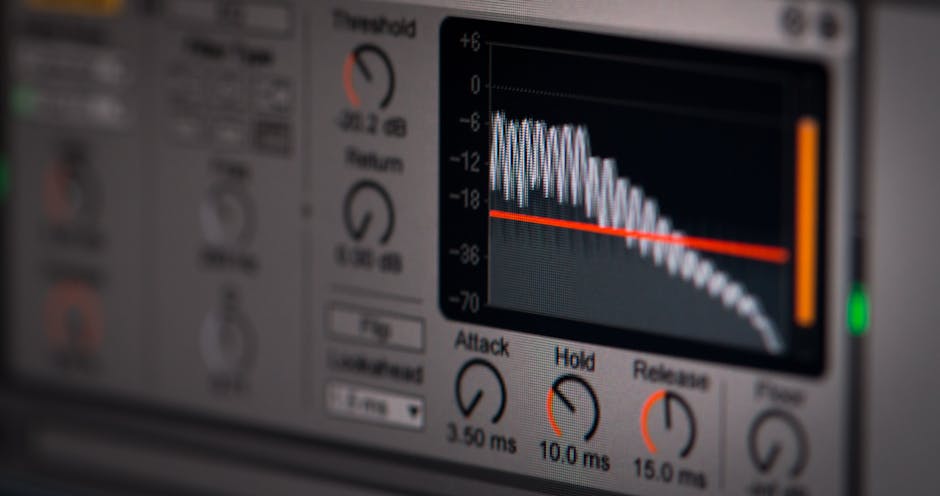
When noise is already present in a recording, noise reduction tools become indispensable. Modern software has achieved significant advancements in this field, with plugins incorporating artificial intelligence algorithms to discern between the desired signal and noise. Solutions like iZotope RX or Acon Digital Acoustica offer specific modules for eliminating hiss, hum, clicks, wind noise, and even unwanted reverb. These programs work by creating a “noise profile” from a silent section of the recording and then subtracting this footprint from the entire track. Careful application of these tools is crucial to avoid introducing audible artifacts that can affect the naturalness of the sound. Gating and expansion techniques also help suppress noise during pauses, though they require precise adjustment to avoid cutting off important transients. The constant evolution of these technologies redefines what is possible in audio restoration, even for recordings with considerable challenges.
The ability to analyze and manage noise is a cornerstone of high-quality audio production. In a landscape where expectations for sound fidelity are ever-increasing, especially with the rise of immersive and spatial audio, every detail counts. Implementing a rigorous methodology for identifying noise sources and applying attenuation techniques, whether preventive or restorative, not only optimizes technical quality but also enhances the artistic expression of any work. Staying abreast of innovations in audio software and hardware is an ongoing commitment for any professional aspiring to excellence in sound treatment.
Related Posts

The Muscle Shoals Sound: Acoustic Engineering and Cultural Legacy in Contemporary Music
An analysis of the Muscle Shoals sonic phenomenon, its recording techniques, and its enduring influence on modern music production.

PreSonus Studio One: Architecture, Features, and Evolution in Modern Music Production
Analysis of PreSonus Studio One's architecture, innovations, and application in contemporary music production workflows.

Concatenative Synthesis: Principles, Evolution, and Applications in Synthetic Audio
Explore the fundamentals of concatenative synthesis, from its operational principles to its impact on TTS and experimental sound design.

Brainwave Modulation Through Acoustics: Principles, Synthesis, and Applications
Investigating psychoacoustics and neuroscience to design sound experiences influencing cognitive and emotional states.