Studio Monitoring Fundamentals: Components, Acoustics, and Calibration for Sonic Fidelity
Technical analysis of speakers, interfaces, acoustic treatment, and calibration for precise audio reproduction in professional environments.
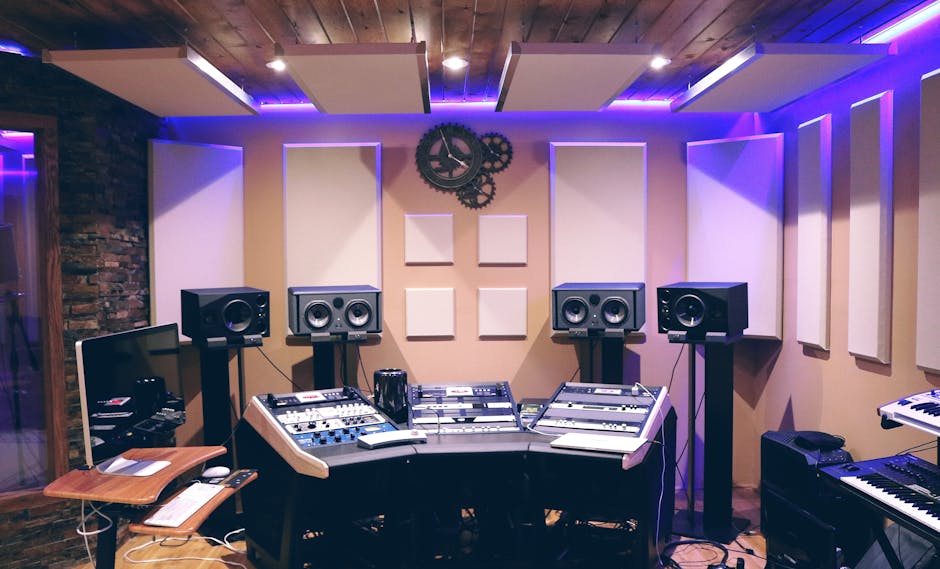
Fundamentals of Professional Audio Monitoring
Sonic accuracy is a cornerstone for any audio professional. In music production and post-production, the ability to perceive sound impartially and in detail is essential for making sound technical judgments during mixing and mastering processes. A properly configured monitoring system not only reveals the intrinsic characteristics of a recording but also prevents costly errors, ensuring that decisions made in the studio translate faithfully across diverse playback environments, from streaming platforms to live sound systems. In this context, understanding the fundamentals of monitoring becomes indispensable for achieving high-quality results in today’s sound industry, where fidelity and consistency are highly valued by the global audience.
A robust monitoring system comprises several interconnected elements, each playing a critical role in the audio chain. Studio loudspeakers, commonly referred to as ‘monitors,’ are the central piece. Active monitors, which incorporate internal amplification and often offer optimized frequency response via DSP (Digital Signal Processing), and passive monitors, which require an external amplifier, are the main types. The choice between nearfield and midfield monitors depends on the studio size and listening distance. Brands like Neumann, Genelec, or Focal offer solutions integrating advanced technologies for transparent reproduction.
Beyond the speakers, the audio interface or D/A (Digital-to-Analog) converter plays a crucial role, as its quality directly impacts signal fidelity before it reaches the monitors. Devices from manufacturers such as Universal Audio or RME are recognized for their pristine conversion. Likewise, interconnect cables, though often underestimated, must be high-quality to avoid signal loss or interference. The integration of monitor controllers, like those from SPL or Grace Design, allows for centralized management of audio sources, volume levels, and selection of alternative monitors, facilitating mix validation across different systems. Recent evolution in this field includes monitors with network connectivity and automatic calibration, adapting to the demands of modern workflows.
Key Components of an Effective Monitoring System
The quality of the monitoring system is only as good as the acoustics of the space it’s used in. Even the most accurate speakers can sound misleading in an untreated room. Common acoustic problems include early reflections, standing waves, and excessive reverberation. Early reflections, which occur when sound bounces off walls, ceilings, or desks before reaching the ears, can alter the stereo image and frequency response. Standing waves, on the other hand, cause peaks and dips in the low-frequency response, making certain notes sound louder or quieter than they actually are.
To mitigate these issues, various acoustic treatment solutions are employed. Absorption panels, typically placed at first reflection points and in corners to control low frequencies (bass traps), reduce reverberation and resonances. Diffusers, conversely, scatter sound, helping to create a more uniform and natural sound field. Acoustic analysis tools like Room EQ Wizard or calibration systems such as Sonarworks Reference 4 allow for room response measurement and application of parametric corrections to linearize the perceived frequency response. Implementing proper acoustic treatment is an investment that significantly optimizes monitoring accuracy, allowing the engineer to hear the mix, not the room.
Once the components are established and acoustic treatment has been addressed, fine-tuning the system’s calibration is crucial. Monitor positioning is vital: they should form an equilateral triangle with the listener’s head, with tweeters at ear height. This establishes the listening ‘sweet spot,’ where the stereo image is most coherent and the frequency response is most balanced. The tilt of the monitors also influences this; they should point directly towards the sweet spot.
Acoustic Treatment and Room Calibration
Leveling the monitors is another fundamental step. Using an SPL (Sound Pressure Level) meter to adjust the volume of each monitor to a standard reference level (e.g., 83 dB SPL for pink noise at -20 dBFS) ensures no volume imbalances between the left and right channels. Many studios employ room correction software, like the aforementioned Sonarworks or Dirac Live, which uses a measurement microphone to analyze the room’s acoustics and apply equalization filters to compensate for room and monitor deficiencies. This technology, powered by advanced algorithms, enables a flatter, more neutral listening experience, replicating reference environments and facilitating critical mixing decisions, especially relevant in immersive audio production where spatial coherence is paramount.
The studio monitoring landscape is constantly evolving, driven by new technologies and production methodologies. A significant trend is the increasing sophistication of AI-based room correction systems, offering more precise and adaptive optimization than ever before. These systems not only correct frequency response but also address phase and transient response, crucial aspects for sonic clarity and definition.
Immersive audio production, such as Dolby Atmos and Sony 360 Reality Audio, has redefined monitoring requirements, shifting from stereo setups to complex multichannel systems (7.1.4 or higher). This presents challenges in spatial calibration and managing a larger number of speakers. In response, monitors with integrated DSP have emerged, facilitating the setup of these complex environments by offering bass management and time-alignment tools.
Advances and Trends in Studio Monitoring Systems
Studio headphones have also gained prominence, especially for remote production and portable monitoring. With the aid of room emulation and headphone response correction software (like Waves Nx or the aforementioned Sonarworks SoundID Reference for Headphones), it’s possible to simulate professional mixing environments and achieve a more linear response, mitigating the inherent variations of each headphone model. Virtual and augmented reality also loom as future tools for visualizing and monitoring acoustic spaces, although their practical application in professional studios is still developing. These collective advancements point toward a future where listening will be even more precise, adaptable, and accessible to audio professionals worldwide.
Building an accurate monitoring system and an optimized acoustic environment is not a luxury but a necessity for any engineer or producer pursuing sonic excellence. From selecting speakers and converters to acoustic treatment and meticulous calibration, each step contributes to a truthful representation of the sound material. Investing in these fundamentals translates directly into more balanced mixes, impactful masters, and ultimately, productions that resonate with the expected quality in today’s competitive music industry. Staying abreast of technological innovations in monitoring, such as AI-driven room correction and adaptations for immersive audio, ensures the studio remains at the cutting edge, prepared for the challenges and opportunities of the sonic future.
Related Posts

Oberheim's Analog Legacy: Evolution, Architectures, and Sonic Resurgence
Technical analysis of Oberheim's influence on analog synthesis, from the SEM to the OB-X8, and its impact on modern music production.

Artificial Intelligence in Audio Mixing: Towards Augmented Soundscapes and Dynamic Spatialization
Explore how AI is redefining audio mixing, enabling immersive and adaptive experiences beyond stereo and surround sound.

Organic Vocals: Mastering Subtle Pitch Correction for Authentic Performances
Discover how to achieve polished, natural-sounding vocals without sacrificing the raw emotion and authenticity of a performance in your music productions.

Cinematic Sound Design: Ambience, Foley, and Processing Techniques for Immersive Narratives
Exploring cinematic sound design techniques, from field recording to AI, to craft engaging auditory experiences.