Fingerpicking vs. Strumming: Sonic Differences and Miking Strategies for Acoustic Guitar
Exploring acoustic distinctions between fingerpicking and strumming, and their influence on miking and processing techniques.
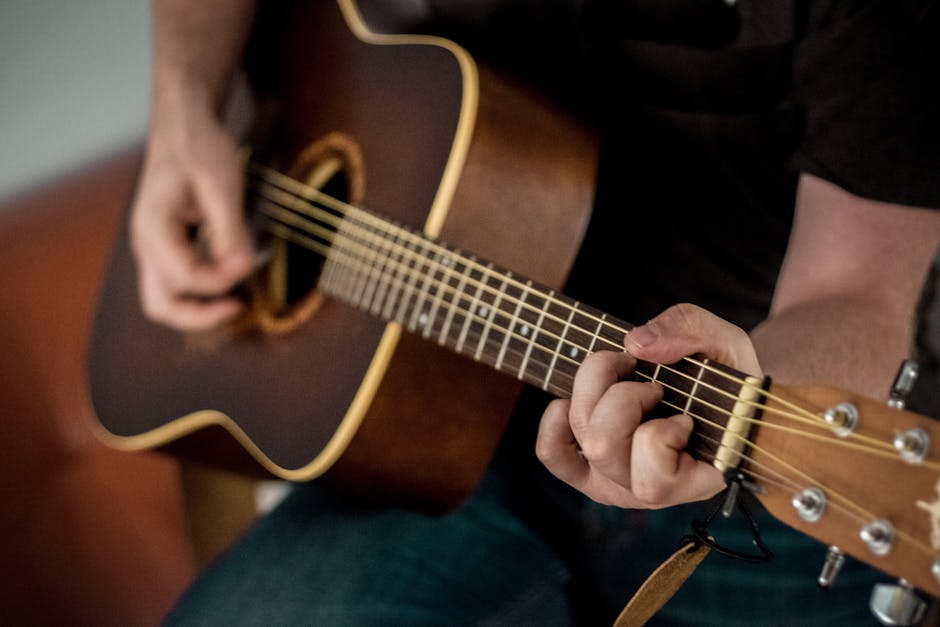
Sonic Differences: Fingerpicking vs. Strumming on Acoustic Guitar
The recording of acoustic guitar presents unique challenges, given the instrument’s harmonic and dynamic complexity. The choice of playing technique, whether fingerpicking or strumming, not only defines the musical character but also fundamentally dictates the miking strategy, signal processing, and ultimately, the final sonic outcome. Understanding the inherent differences between these two approaches is crucial for capturing the essence of the performance and ensuring optimal integration into any mix.
The fingerpicking technique is characterized by the individual articulation of the strings, generating a detailed, intimate sound with a subtle dynamic range. Each note and its transient are prominent, requiring a capture that preserves clarity and separation. On the other hand, strumming involves a simultaneous or near-simultaneous attack on multiple strings, producing a broader, more energetic sound with considerable harmonic body. Here, the challenge lies in capturing the fullness and dynamics of the chord without incurring unwanted resonances or volume peaks that can saturate the signal. These acoustic distinctions are the starting point for any effective recording methodology.
Miking Methodologies for Detailed and Immersive Capture
Regarding miking methodologies, for fingerpicking, precision is the priority. Small-diaphragm condenser microphones (SDCs), such as a Neumann KM 184 or a Rode NT5, are ideal due to their fast transient response and ability to capture fine details. Their positioning is often closer to the guitar’s soundhole or the 12th fret, seeking a balance between string attack and body resonance. This is frequently complemented by a large-diaphragm condenser microphone (LDC), like an AKG C414, positioned slightly further back to add body and warmth. Stereo configurations like XY or ORTF can provide a coherent and articulated spatial image.
For strumming, capturing the instrument’s body and overall energy is paramount. LDCs are preferable, placed at a slightly greater distance to allow the sound to develop and to capture the guitar’s interaction with the room. A pair of microphones configured in AB (spaced) can offer a wide and immersive stereo image, ideal for the expansive character of strumming. It is essential to adjust the distance to avoid excessive proximity effect and the capture of harsh harmonics.
Signal Processing: EQ and Compression Tailored to Each Technique
Post-recording signal processing also differs significantly. For a fingerpicking track, equalization (EQ) often involves surgical cuts in the low and low-mid frequencies (between 150-300 Hz) to eliminate “mud” or “boxiness,” and subtle boosts in the upper-mid frequencies (2-5 kHz) and treble (10-15 kHz) to enhance clarity and brightness. Compression should be transparent, with low ratios (1.5:1 to 3:1), fast attacks to control transients, and medium releases to maintain sustain. This helps level the dynamics without crushing expressiveness. Plugins like the Universal Audio Teletronix LA-2A are excellent for smooth compression.
In the case of strumming, EQ may require broader cuts in the low frequencies if there is excessive resonance, and boosts in the presence range (1-4 kHz) to make the strumming cut through the mix. Compression is typically more energetic, with medium-high ratios (3:1 to 5:1) and a slower attack to allow the initial transient of the strum to pass through, followed by a quick release for a rhythmic effect. Parallel compression is a valuable technique for adding density and punch without sacrificing original dynamics. VCA-style compressors, such as the SSL G-Comp or emulations like the Waves CLA-76, are frequently used.
The application of reverb and delay should be more subtle in fingerpicking to preserve articulation, while in strumming, it can be used more freely to add space and cohesion to the mix.
Current Trends and Innovations in Acoustic Guitar Production
Current trends in music production offer innovative tools for refining acoustic guitar recording. Microphone modeling plugins, such as Universal Audio Sphere or Antelope Audio Edge, allow emulation of classic microphones and adjustment of polar patterns post-recording, providing unprecedented flexibility. Emulations of analog preamplifiers and consoles, like those from Neve 1073 or SSL 4000 E, available through platforms like Universal Audio, can infuse warmth and character from the input stage. Furthermore, AI-assisted mixing tools, such as iZotope Neutron or Soundtheory Gullfoss, analyze the guitar’s spectrum and suggest EQ or compression adjustments to optimize tonal balance and clarity, accelerating the workflow.
Hybrid production, combining high-end analog equipment with advanced digital processing, remains a dominant practice. Likewise, integration with cloud collaboration platforms, such as Splice Studio, facilitates experimentation and remote work with other musicians, allowing for sharing and refining acoustic guitar recordings in real-time. These innovations not only enhance technical quality but also expand creative possibilities for producers worldwide.
In summary, effective acoustic guitar recording, whether for fingerpicking or strumming, demands a deep understanding of the sonic characteristics of each technique and an informed application of miking and processing strategies. There is no single solution; the key lies in conscious experimentation, critical listening, and adaptation to the particularities of each performance and musical context. By integrating traditional methodologies with current technological innovations, producers can elevate the quality of their recordings and capture the true essence of this versatile instrument.
Related Posts

Unveiling Divididos' Studio Alchemy: Crafting Raw Power and Sonic Identity
Uncover the studio alchemy behind Divididos' legendary sound, exploring their raw recording techniques, gear choices, and mixing philosophy that inspire authentic rock production.

Technological Innovations in Contemporary New Age Music Composition and Sound Design
Exploring advanced synthesis, immersive audio, and collaborative workflows shaping modern New Age music production.

Ondes Martenot and Historical Synthesizers: Recording, Processing, and Sonic Legacy
Technical analysis of recording pioneering electronic instruments, from Ondes Martenot to Mellotron, and their current relevance.

Capturing and Processing Gestural Instruments: Theremin and Beyond in Music Production
Technical analysis of recording and post-production for theremins and gestural instruments to maximize expressiveness and sonic fidelity.