Room Acoustics in Home Studios: Principles and Applications for Accurate Monitoring
Control your workspace acoustics: reflections, absorption, and diffusion to optimize listening and mixing decisions.

Fundamentals of Spatial Acoustics in Music Production
The pursuit of impeccable sound quality in music production often centers on high-end gear, sophisticated plugins, and advanced mixing techniques. However, a fundamental factor frequently underestimated, especially in home studio environments, is the acoustics of the space. The listening or recording room acts as a primary filter, modifying the audio signal before it reaches our ears or microphones, which can severely distort perception and, consequently, creative and technical decisions. Understanding the basic principles of acoustics and applying appropriate treatments is crucial for establishing a reliable working environment and achieving professional results.
The behavior of sound in an enclosed space is governed by phenomena such as reflection, absorption, and diffusion. Reflections are sound waves that bounce off the room’s surfaces, reaching the listener with a slight delay and creating unwanted echoes or reverberations. In a home studio, where walls are often parallel and hard, early reflections and flutter echo are common problems that can cloud the stereo image and transient clarity. Absorption aims to reduce these reflections by converting sound energy into heat, using porous materials like acoustic foam, mineral wool, or fiberglass. On the other hand, diffusion scatters sound waves in multiple directions, preserving energy but breaking up direct reflection patterns, which contributes to a larger sense of space and a more uniform frequency response. The strategic implementation of these treatments allows for control over reverberation and mitigation of unwanted room modes, significantly improving monitoring accuracy.
Principles of Sound Absorption and Diffusion
The practical application of acoustic treatments in a home studio requires careful planning. First reflection points, meaning the areas where sound from the monitors first bounces before reaching the listening position, are priorities for placing absorbent panels. These are typically located on the side walls, ceiling, and front wall. To control low frequencies, bass traps in the corners are indispensable, as this is where low-frequency waves tend to accumulate with the greatest intensity. The rear of the room can benefit from diffusers, especially if space allows, to prevent an excessively dry reverberant field. Currently, the market offers modular and aesthetically integrated solutions, such as Auralex acoustic panels (https://www.auralex.com/), which facilitate adaptation to various environments without compromising aesthetics. For those seeking more budget-friendly options, building DIY panels with mineral wool and fabric can be a viable alternative, always prioritizing material safety and performance.
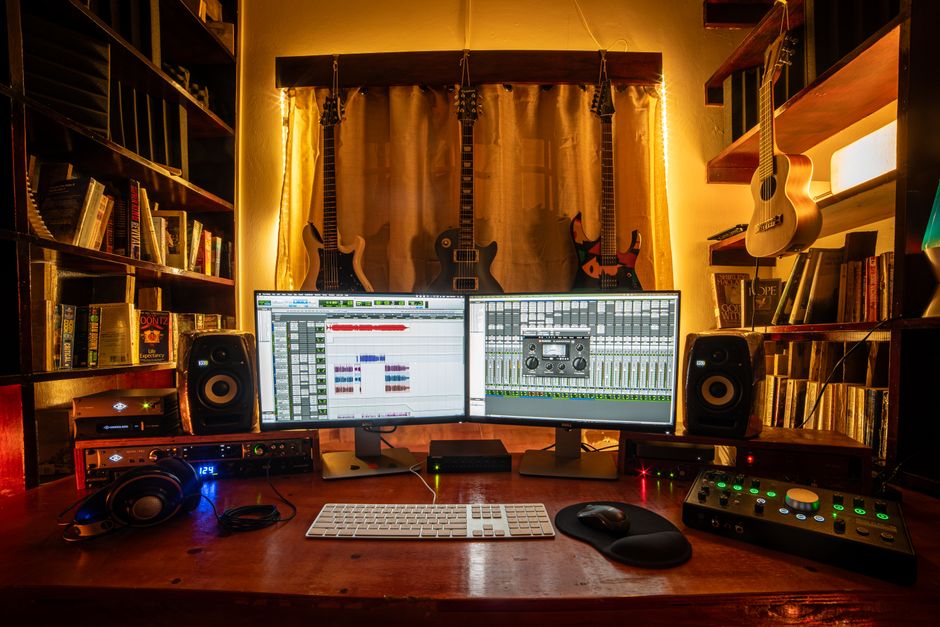
The precise placement of studio monitors and the listening position are as critical as acoustic treatment. It is strongly recommended to establish an equilateral triangle between the two monitors and the listener’s head, with the tweeters at ear level. The distance of the monitors from walls is a determining factor; moving them away from corners and hard surfaces helps reduce phase interactions and unwanted bass buildup. Using decoupled monitor stands (pads or isolation stands) minimizes vibration transfer to the desk or floor, which could color the frequency response. Manufacturers like Genelec offer detailed guides on correct monitor placement to optimize listening (https://www.genelec.com/correct-loudspeaker-placement). Additionally, the integration of DSP-based room correction systems, such as Sonarworks SoundID Reference (https://www.sonarworks.com/soundid-reference/), has become an invaluable tool. These systems measure the room’s frequency and phase response and apply inverse equalization to linearize the perceived response, compensating for remaining acoustic imperfections and enabling more accurate decision-making during mixing and mastering.
Practical Application of Acoustic Treatments
Technological innovations continue to transform how we approach acoustics in home studios. Artificial intelligence and machine learning are beginning to be integrated into acoustic analysis tools, offering more precise diagnostics and personalized treatment recommendations. Furthermore, the growing popularity of immersive audio formats, such as Dolby Atmos, presents new challenges and opportunities for home producers. While a certified Atmos studio requires a significant investment, understanding acoustic principles is fundamental to adapting smaller spaces and configuring expanded monitoring systems, even with virtual setups, that allow for pre-production and basic monitoring of spatial content. The ability to work collaboratively and remotely also underscores the importance of having a reliable and consistent listening environment, as decisions made in one studio must translate faithfully to other systems. Understanding and applying acoustic fundamentals not only optimizes existing equipment but also prepares producers for future industry trends, ensuring that productions maintain their sonic integrity across any platform.
Related Posts

Audio Mastering for Streaming: LUFS Standards, Dynamic Processing, and Codec Optimization
Explore the technical fundamentals of audio mastering for streaming platforms, covering LUFS, dynamic processing, and codec selection.
Vocal Formant Manipulation: Modulating Character and Timbre Without Altering Pitch
Explore formant manipulation to alter vocal character in audio production, music, and film.

Reaper Architecture: Efficiency, Customization, and Adaptability in Modern Music Production
Explore Reaper's architecture, customization, and efficiency for modern workflows, including immersive audio and AI.
Audio Automation: Dynamic Sculpting and Sonic Evolution in Contemporary Music Production
Explore audio automation for adding movement and expressiveness to mixes, from basic adjustments to advanced techniques and AI assistance.