Timbral Authenticity: Acoustic Parameters, Spectral Analysis, and Subjective Perception
Evaluating sonic fidelity: acoustic fundamentals, analysis tools, and human perception's influence on production.

Acoustic Foundations of Timbral Authenticity
In the vast universe of music production and sound engineering, timbral authenticity stands as a fundamental pillar for the quality and credibility of a work. It refers to the fidelity with which a sound reproduces the inherent tonal characteristics of its source—be it an acoustic instrument, a voice, or a synthesizer—while maintaining the original intention of the performer or sound designer. Measuring this authenticity is no trivial task, as it fuses objective parameters with the inevitable subjectivity of human perception. Understanding its foundations is crucial for any professional seeking excellence in their productions, from capture to final mastering.
The bedrock of timbral authenticity lies in comprehending the acoustic parameters that define a sound. The harmonic spectrum, composed of the fundamental frequency and its overtones (harmonics and inharmonic partials), is the DNA of every timbre. The richness and distribution of these harmonics determine whether a violin sounds like a violin or if a voice retains its distinctive character. Added to this is the ADSR envelope (Attack, Decay, Sustain, Release), which describes how a sound evolves over time, from its initial onset to its fade-out. A fast attack and short decay characterize percussion, while a prolonged sustain defines a synthesizer pad. Altering these elements can distort the perceived authenticity of the timbre. Furthermore, formants, which are fixed resonant frequency bands, contribute significantly to vocal intelligibility and the distinctive character of many instruments, such as woodwinds and strings. Even noise, in its non-harmonic components, can be a determining factor; the breathiness of a flute or the scrape of a violin bow are intrinsic elements that contribute to timbral authenticity, not mere unwanted artifacts.
Analysis Tools for Timbral Quantification
To quantify and evaluate these attributes, modern audio engineering employs advanced analysis tools. Spectrum analyzers, found in plugins like FabFilter Pro-Q 3 or iZotope Insight 2, allow for real-time visualization of frequency energy distribution, identifying unwanted resonances or spectral deficiencies that compromise authenticity. Phase analysis is equally vital, revealing coherence issues that can affect timbre’s spatiality and solidity, especially in multi-microphone recordings. Phase correlation tools are indispensable for ensuring mono compatibility of a mix, a critical aspect in today’s content distribution. Beyond visualization, measuring the temporal envelope through level and dynamics meters helps understand how transients and the body of a sound behave. Recent innovations include plugins with artificial intelligence, such as Sonible smart:EQ 3 or iZotope Ozone’s mastering assistants, which offer equalization and tonal balance suggestions based on advanced spectral analysis, aiming to preserve or restore timbral authenticity more efficiently. These advancements do not replace the human ear but complement it, offering an objective perspective to guide creative decisions.
However, the objective measurement of timbral parameters must coexist with the intrinsic subjectivity of human perception. Psychoacoustics teaches us that our brain interprets sound in complex ways, influenced by musical context, familiarity, and cultural expectations. A timbre may be technically “perfect” in its reproduction, but if it fails to evoke the desired emotion or intention, its artistic “authenticity” can be questioned. In this regard, calibrating the listening environment and using precise reference monitors are fundamental for making informed decisions. Timbral authenticity also takes on new dimensions in the context of current trends, such as immersive audio (Dolby Atmos) and high-resolution streaming platforms. In these formats, timbre fidelity becomes even more critical, as any artifact or distortion is magnified in a three-dimensional space or with a wider dynamic range. Remote collaborative production also presents challenges, requiring rigorous standards and shared analysis tools to ensure timbral consistency across different stages and collaborators.
Subjective Perception and Context in Timbral Evaluation
In summary, measuring timbral authenticity is a multifaceted process demanding a solid understanding of acoustic principles and proficiency in using analysis tools, without losing sight of the subjective essence of auditory perception. The integration of emerging technologies, such as artificial intelligence, offers new avenues for optimizing this process, but critical listening remains the ultimate judge. For audio professionals worldwide, mastering these fundamentals not only elevates the technical quality of their productions but also enriches artistic expression, ensuring that each sound communicates its message with the utmost fidelity and truth. It is a constant balance between science and art, where the pursuit of authenticity is a continuous and enriching journey. To delve deeper into the understanding of auditory perception, one can consult specialized resources linking to Sound on Sound on psychoacoustics. To explore the capabilities of modern spectrum analyzers, visit the pages for FabFilter Pro-Q 3 or iZotope Ozone. For more on immersive audio, the Dolby Atmos site offers relevant information.
Related Posts

The Evolution of Multitrack Recording: From Les Paul to AI and Immersive Audio
A historical and technological analysis of multitrack recording, from its analog origins to digital and AI innovations.

Harmonic Distortion: Generation, Types, and Application in Sound Production
Analysis of harmonic distortion: how its even and odd harmonics shape timbre and enrich the sound spectrum.
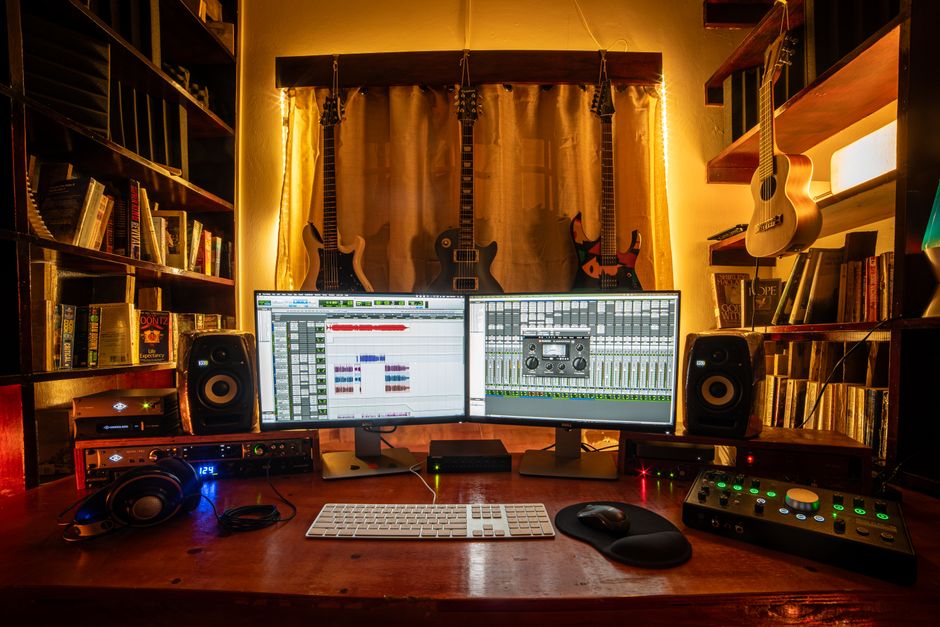
Pro Tools: Architecture, Advanced Editing, and Immersive Workflows in Contemporary Music Production
Analysis of Pro Tools' capabilities for recording, editing, mixing, Dolby Atmos, and remote collaboration in the music industry.

Capturing Reed Instruments: Advanced Miking and Processing Techniques
Optimize bagpipe, oboe, and saxophone recordings with strategic miking and cutting-edge audio processing for professional results.