The MIDI Protocol: Genesis, Evolution, and Foundation of Digital Music Production
Explore the development of the MIDI standard, its role in interconnecting electronic instruments, and its lasting impact on modern music creation.

The Birth of the MIDI Standard: From Utopia to Interoperability
The interconnection of electronic musical instruments, a utopia for composers and producers in the 1970s and 1980s, materialized with the arrival of the MIDI (Musical Instrument Digital Interface) standard. This protocol, which celebrated its fortieth anniversary in 2023, radically transformed music production, allowing synthesizers, drum machines, and computers to communicate with each other. Before MIDI, synchronization and control between devices from different manufacturers were arduous, often impossible, tasks, limiting creativity and efficiency in the studio. Each brand developed its own proprietary systems, creating a fragmented ecosystem where interoperability was a chimera.
MIDI 1.0: Milestones and the Democratization of Music Production
The path towards a common language for electronic instruments began with visionaries like Dave Smith of Sequential Circuits and Chet Wood of Oberheim, who recognized the need for a universal standard. Following meetings and discussions at the Audio Engineering Society (AES) and the NAMM Show in the early 80s, a crucial alliance was forged. Smith’s initial proposal, called the Universal Synthesizer Interface (USI), evolved into MIDI 1.0, officially presented in 1983. This milestone not only facilitated communication between equipment but also democratized music production, opening the doors to an era of sonic experimentation and the creation of accessible home studios. The ability to send note, velocity, pitch bend, and modulation data through a single five-pin cable was revolutionary, eliminating the need for costly and complex analog control systems.
Architecture and Application of Early MIDI Devices
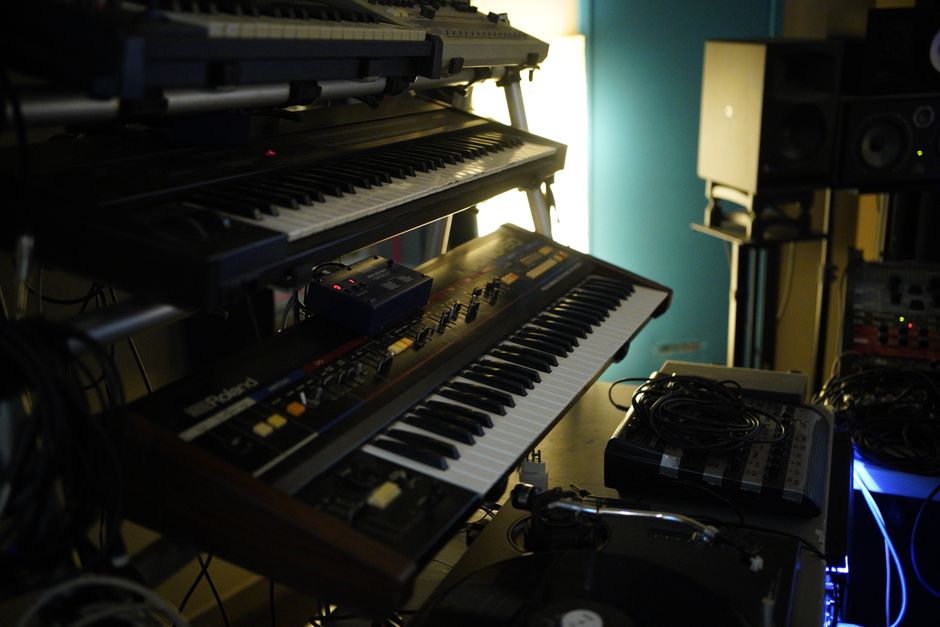
Early MIDI controllers were mostly master keyboards designed to send messages to other slave synthesizers without generating sound themselves. Models like the Sequential Circuits Prophet 600 and the Roland Jupiter-6 were among the first synthesizers to implement the new standard, demonstrating its potential when controlled by master keyboards such as the Yamaha KX88 or the Oberheim Xk. These early devices established the control paradigm that endures to this day, allowing musicians to orchestrate complex arrangements from a single control point. Concurrently, the emergence of the first MIDI sequencers, both in dedicated hardware and nascent software for computers like the Apple II or the Commodore 64, marked a qualitative leap. Musicians could record, edit, and play back note sequences with unprecedented precision, freeing them from the limitations of real-time performance and opening new avenues for algorithmic composition and rhythmic experimentation. The interconnection of a master keyboard with a sound module and a sequencer became the standard configuration for many studios of the era, laying the groundwork for the modern digital audio workstation (DAW).
MIDI’s Legacy in Contemporary and Future Music Production
MIDI’s impact on music production was immediate and profound. It allowed artists and producers to create orchestral arrangements with a fraction of the budget and space required by traditional methods. The ability to program and automate sound parameters opened a new universe of creative possibilities. Today, the essence of MIDI remains fundamental, although it has evolved significantly. The advent of MIDI 2.0, with its bidirectional communication and higher resolution, represents a vital modernization for the demands of contemporary production. Furthermore, the integration of MIDI into virtual environments, software control via touch interfaces, and the proliferation of genre- or task-specific controllers (such as pad controllers or control surface controllers for DAWs) demonstrate its adaptability. Artificial intelligence in music, for example, uses protocols similar to MIDI to generate and manipulate melodic and harmonic sequences, directly connecting with the legacy of its early controllers and the vision of a universal musical language. Platforms like Ableton Live or Logic Pro X, widely used by producers in Argentina and the rest of Latin America, intrinsically rely on the flexibility MIDI offers for interaction with virtual instruments and external hardware, evidencing that, even as technology advances, the principles of digital interconnectivity established by MIDI pioneers remain the backbone of modern music creation. Constant innovation in controllers, from the most traditional to the most experimental, ensures that MIDI, in its various forms, will continue to be an indispensable tool for global musical expression. For those interested in delving deeper into the history and technical details of this standard, the official documentation from the MIDI Association (https://www.midi.org/) offers an invaluable resource.
Related Posts

Digital Performer: From MIDI Sequencer to Comprehensive DAW and Its Technological Influence
An examination of Digital Performer's progression, innovations, and its ongoing impact on modern music and audiovisual production.

The Oberheim Legacy: Sound Architecture, Polyphony, and Iconic Analog Tone
Dive into Oberheim's analog engineering, from the SEM to the OB series, and its lasting impact on electronic music.
Integrating Vintage Electronic Instruments: Preparation, Capture, and Processing in Modern Workflows
Methodologies for capturing and processing vintage synthesizers and drum machines, ensuring sonic authenticity in current productions.

Spatial Audio in VR: Techniques, Workflows, and Creative Considerations for Immersive Production
Explore binaural audio, Ambisonics, and object-based audio for creating immersive VR soundscapes.