Harrison Mixbus: Analog Console Emulation and Digital Workflow for Audio Engineers
An analysis of the Harrison Mixbus mixing engine, its processing architecture, and practical applications in modern music production.

Analog Console Emulation: The Core of Harrison Mixbus
Harrison Mixbus stands out in the music production software landscape with its singular focus on analog console emulation. Unlike other digital workflows, Mixbus integrates a mixing engine that replicates the circuit behavior of legendary Harrison consoles, offering an intuitive workflow and a characteristic sound from the outset. This distinctiveness positions it as a valuable tool for engineers and producers seeking the warmth and depth of analog hardware within a digital environment, without the inherent complexity of physical setups.
The technical foundation of Mixbus lies in its signal processing architecture. Versions like Mixbus 32C are built upon the legacy of the Harrison 32 Series consoles, integrating a pre-routed processing chain on each channel and bus. This means each track features 3 or 4-band equalization, compression, gating, and tape saturation, configured in a fixed manner to emulate the behavior of their analog counterparts. This approach eliminates the need to load individual plugins on each insert, streamlining the creative process and encouraging more musical, less technical decision-making. The summing of internal buses is designed to replicate the interaction of analog components, impacting stereo depth and overall mix cohesion. The “stage gain” philosophy inherent in Harrison’s analog design translates into subtle coloration and pleasing harmonics that contribute to the software’s distinctive sound. This sonic consistency results in reduced perceived latency and an analog “sweet spot” that can accelerate mixing processes.
Signal Processing Architecture and Stage Gain
Despite its focus on analog emulation, Mixbus is a modern and adaptable digital workflow environment. It offers full support for MIDI tracks, virtual instruments (VST/AU), and high-resolution multitrack recording, enabling its integration into contemporary workflows. Its compatibility with external plugins is crucial, allowing for the incorporation of cutting-edge tools, such as recent AI-based plugins for audio restoration, mixing assistance, or creative effects. For example, combining a third-party intelligent compressor with Mixbus’s native tape saturation can achieve controlled dynamics and distinctive color. The routing flexibility allows for hybrid configurations, integrating external preamplifiers or effects processors via hardware inserts, leveraging the best of both worlds. The open-source foundation of Ardour, upon which Mixbus is built, ensures a robust and adaptable platform for future innovations and facilitates remote collaboration by enabling project exchange compatible with other Ardour-based platforms. Detailed information about its development is available on the official Ardour website: https://ardour.org/.
Regarding practical applications and its relevance in the current audio landscape, Mixbus offers significant advantages. For drum mixing, the channel EQ and gentle compression can be applied to each element (kick, snare, toms) to achieve punch and cohesion, subsequently using the drum bus for subtle global saturation that unifies the ensemble. In vocal processing, Mixbus’s native processing chain is effective for sculpting critical frequencies and adding warmth without resorting to multiple plugins, where saturation can impart presence and body. Although not a dedicated mastering DAW, the quality of its internal summing and its master bus tools (3-band EQ, compressor, limiter) make it ideal for robust pre-mastering before sending to a specialized engineer. The demand for “vintage” sound and analog emulation remains a strong trend in current production, and Mixbus directly addresses this need. Furthermore, a clear mix with good dynamic separation, facilitated by Mixbus, is fundamental for correct encoding on streaming platforms like Spotify or for subsequent spatialization in immersive audio formats like Dolby Atmos. Phase accuracy and stereo imaging are critical in these scenarios. Constant monitoring across different systems is essential to ensure mix portability, a universal principle enhanced by the sonic transparency Mixbus can offer. More details about Mixbus’s features are on its official website: https://harrisonconsoles.com/mixbus.
Modern Digital Integration and Plugin Compatibility
Harrison Mixbus represents a powerful and characterful alternative for contemporary music production. Its integrated analog console philosophy offers a direct path to a professional sound, while its compatibility with modern technologies keeps it relevant in an ever-evolving landscape. For those who value the sound of classic consoles and a workflow focused on musicality, Mixbus is a tool of considerable interest that deserves in-depth exploration to optimize current productions.
Related Posts

Additive Synthesis: Sonic Architecture and Detailed Harmonic Control
Explore the construction of complex timbres by summing sine oscillators and granular control of harmonic partials.

Generative Sound Design: Algorithmic Principles for Dynamic Audio Landscapes
Research into creating audio via algorithms and autonomous systems, exploring applications in immersive and interactive experiences.

Hindenburg Pro: Workflow Optimization for Focused Vocal and Music Production
An examination of Hindenburg Pro's architecture, highlighting its focus on efficient audio capture, editing, and processing for creators.
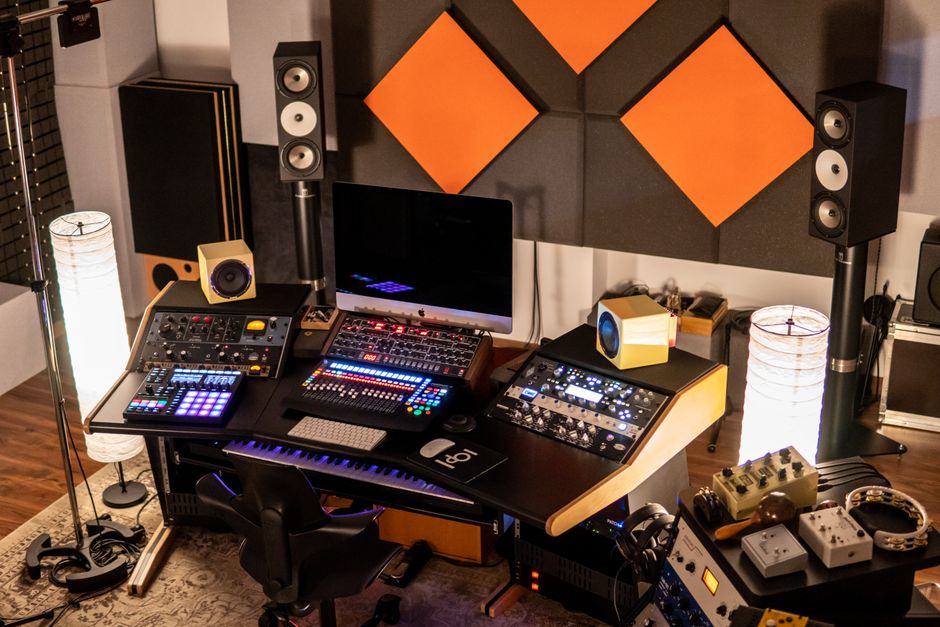
Optimizing Acoustic Monitoring Systems for Professional Audio Engineering
Design principles, component selection, and calibration for critical listening environments in music production.