Microphone Principles and Processing for Bowed String Acoustic Capture
We cover spatial acoustics, microphone selection, and post-production techniques for faithful recordings of violin, cello, and double bass.

Space Acoustics and Instrument Positioning
Faithfully capturing bowed string instruments presents a significant technical and artistic challenge in music production. The complex resonance of a violin, the depth of a cello, or the harmonic foundation of a double bass demand a profound understanding of acoustics, microphone techniques, and subsequent processing. The goal is to preserve the instrument’s timbral richness, expressive dynamics, and natural spatiality, while avoiding unwanted artifacts and coloration. This analysis addresses contemporary methodologies and considerations for recording these sound sources, integrating technical perspectives and recent advancements in the professional audio field.
The interaction of the instrument with the acoustic environment is fundamental. A space with controlled reverberation and balanced reflections is preferable. Rooms with excessive damping can produce a “dry” and lifeless sound, while an overly reverberant environment can lead to “muddy” or undefined recordings. It is recommended to experiment with the positioning of the performer and the instrument within the room, seeking optimal spots that allow the sound to develop fully without problematic frequency buildup. For instruments like the violin or viola, a balance is sought between proximity that captures bow detail and distance that allows for body resonance. In the case of the cello and double bass, interaction with the floor and nearby walls can enrich the low-frequency response, although it is crucial to avoid unwanted resonances that might create “boominess”.
Microphone Selection and Capture Techniques
The choice of microphone and miking technique are decisive. Small-diaphragm condenser microphones, such as the Neumann KM 184 or the DPA 4006, are frequently chosen for their extended frequency response and their ability to capture transients with precision, ideal for bow detail and harmonic clarity. Large-diaphragm condenser microphones, like the Neumann U87, can offer additional warmth and presence, especially on cellos and double basses. Ribbon microphones, such as the Royer R-121, provide a characteristic smoothness in the high frequencies, attenuating potential bow harshness and adding vintage richness.
For close miking, a mono technique at approximately 30-60 cm from the instrument can capture direct sound with great detail. For violins, the aim is typically towards the area between the bridge and the fingerboard. On cellos, a common position is in front of the “f-holes” or at bridge height. For double basses, a balance is sought between the body and the fingerboard. Stereo techniques, such as X/Y, A/B, or Mid-Side, are valuable for capturing the spatial image and the breadth of the instrument or a string ensemble. The Mid-Side technique, using a cardioid (Mid) and a figure-of-eight (Side) microphone, offers remarkable flexibility in post-production for adjusting stereo width. Combining a close microphone with an ambient microphone (room mic) can also enrich the recording, providing depth and spatial context.
Signal Processing for Bowed String Instruments
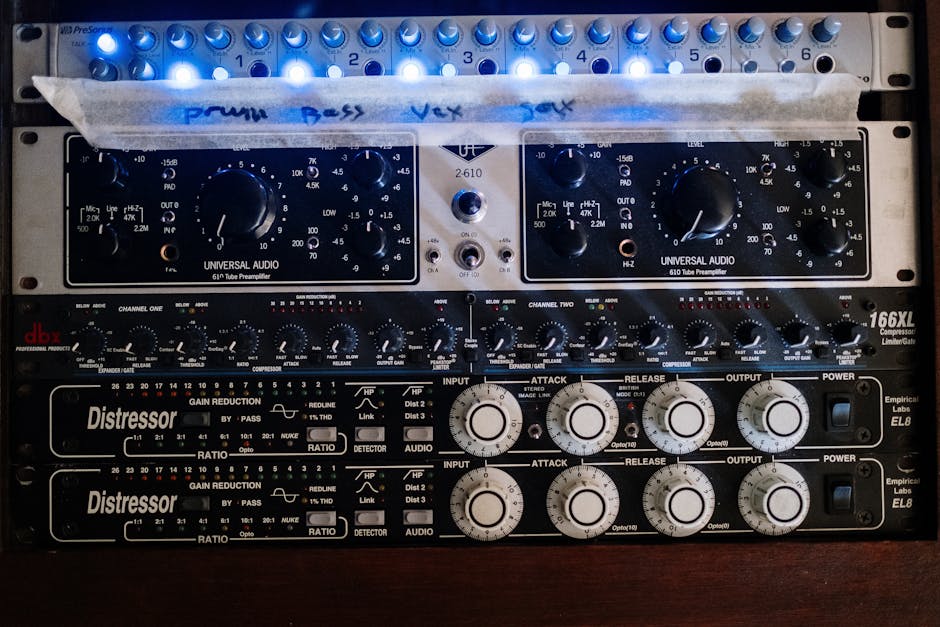
Once the signal is recorded, processing should be subtle and focused on enhancing the instrument’s inherent qualities. Equalization (EQ) is used to correct frequency imbalances; for example, attenuating resonant peaks in the mid-highs that might produce a strident sound or boosting low frequencies to add body. Compression is generally applied lightly, with low ratios and moderate attack and release times, to control dynamics without eliminating the performer’s natural expressiveness. Tools like the Universal Audio LA-2A optical compressor or plugins emulating its behavior are popular choices for transparent and musical compression.
Current trends in music production offer new possibilities. Artificial intelligence (AI) is transforming audio cleaning and restoration tools; plugins like iZotope RX or Acon Digital Acoustica use advanced algorithms to reduce unwanted noise from the environment or the instrument without compromising signal integrity. Remote and collaborative production benefits from platforms like Audiomovers Listento, which allow monitoring of recording sessions with minimal latency and high audio quality, facilitating collaboration between geographically distributed musicians and producers.
Technological Innovations in Audio Recording
Furthermore, the development of immersive music and spatial audio, such as Dolby Atmos, is opening avenues for string instrument mixing. Precise placement of sound sources in a three-dimensional environment can create a deeply immersive auditory experience, especially relevant for orchestral or chamber arrangements. Advanced spatialization plugins allow experimentation with the virtual placement of each instrument, and software like the Dolby Atmos Renderer enables the creation of mixes that transcend traditional stereo.
The recording of bowed string instruments is a process that demands a combination of technical knowledge, musical sensitivity, and continuous adaptation to technological innovations. From the meticulous acoustic preparation of the space and strategic microphone selection, to subsequent processing and the integration of AI tools or spatial audio approaches, each stage contributes to the fidelity and emotional impact of the recording. Staying updated with advancements in hardware, software, and working methodologies is crucial for continuing to elevate the quality of music productions in the contemporary landscape.
Related Posts
Universal Audio 1176 vs. Teletronix LA-2A: Classic Analog Compressor Comparison
Technical comparison of the 1176 FET and LA-2A optical compressor: features, applications, and synergies in modern production.

Perceptual Transparency in Audio: Principles, Evaluation, and Contemporary Technological Application
Analysis of sonic neutrality, objective/subjective evaluation methodologies, and their relevance in high-resolution and immersive audio.

Capturing Bowed Strings: Acoustics, Miking, and Processing for Tonal Fidelity
Explore the complex acoustics of bowed strings, miking techniques, and processing for high-fidelity recordings.

Electric Lady Studios: Acoustic Design, Technological Evolution, and Jimi Hendrix's Creative Legacy
An analysis of the cutting-edge acoustic design, technological adaptation, and lasting impact of Electric Lady Studios on global music production.