Nearfield vs. Midfield Monitors: Acoustic Impact and Technical Selection
Comparative analysis of nearfield and midfield monitors, their acoustic characteristics, and selection criteria for audio studios.
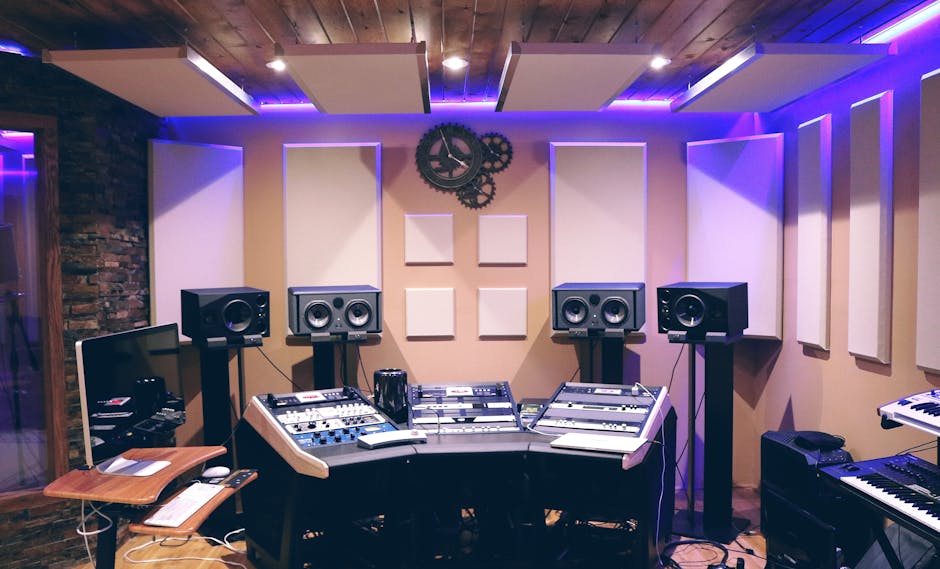
Nearfield Monitors: Detailed Analysis and Applications in Compact Environments
In the realm of music production and sound engineering, listening accuracy is a fundamental pillar for making critical decisions during the mixing and mastering phases. The selection of the appropriate monitoring system directly impacts the engineer’s ability to accurately perceive the stereo image, frequency response, and dynamics of a production. One of the most common dilemmas in setting up a recording or mixing studio revolves around the choice between nearfield and midfield monitors, each with specific characteristics and applications tailored to different acoustic environments and workflows.
Nearfield monitors are designed to be listened to at a relatively short distance, generally between 1 to 1.5 meters (3 to 5 feet). This proximity minimizes the sound’s interaction with the room’s reflective surfaces, thereby reducing the influence of the environment’s acoustics on audio perception. Their compact design and smaller transducers typically offer agile transient response and a defined stereo image, making them ideal tools for detailed analysis of individual elements in a mix. They are particularly valued in smaller studios or home studio setups where acoustic treatment may be limited. The primary advantage lies in the ability to discern subtle nuances, such as compression artifacts, specific resonances, or the precise placement of instruments in the stereo field. However, their low-frequency response may be less deep or less accurate compared to larger systems, and their capacity to generate sustained high sound pressure levels (SPL) is limited, which might not be sufficient for certain applications or for perceiving the physical “feel” of the bass.
Midfield Monitors: Spatial Perception and Overall Balance Evaluation
On the other hand, midfield monitors are conceived for longer listening distances, typically between 2 to 3 meters (6.5 to 10 feet). These systems usually incorporate larger diameter transducers and more powerful amplifiers, enabling them to offer a more extended frequency response, especially in the bass range, and a higher SPL capability. The main advantage of midfield monitors is their ability to present a more coherent soundstage and a broader spatial perception, more faithfully simulating the listening experience in a larger control room or even in a final consumer listening environment. They are valuable tools for evaluating the overall balance of a mix, the relationship between elements in a wider context, and the sense of depth. Their application is frequent in medium to large professional studios, where adequate acoustic treatment is available to allow room reflections to contribute to a more immersive listening experience without introducing unwanted coloration. The inherent disadvantage is that they require a more controlled acoustic environment to perform at their full potential, as their greater power and dispersion make them more susceptible to room interaction.
The choice between nearfield and midfield is not mutually exclusive, and many professional studios opt to combine both systems to gain different listening perspectives. Selection criteria should be based on a rigorous evaluation of several factors. Firstly, the size and acoustics of the control room are decisive; a small space with limited treatment will benefit more from nearfield monitors, while a larger, properly conditioned room can leverage the advantages of midfields. Secondly, the primary purpose of the studio; if the focus is on detailed mixing and mastering, high-quality nearfields are indispensable. If recording sessions with instrumentalists are conducted or references with greater physical “impact” are sought, midfields can complement the listening. Finally, the available budget also plays a role, as midfield systems typically involve a greater investment in both the monitors themselves and the necessary acoustic conditioning for their optimal performance. Precise calibration of any monitoring system, using tools like room correction systems, is crucial to ensure the flattest and most transparent response possible.
Selecting Monitoring Systems: Acoustic and Budgetary Factors
In summary, the differentiation between nearfield and midfield monitors lies in their design and optimal listening distance, which in turn defines their most suitable applications. Nearfields excel at delivering fine details and reducing room influence, ideal for critical analysis in compact environments. Midfields, conversely, offer a broader soundstage, a fuller bass response, and higher SPL, suitable for evaluating overall balance in larger, acoustically treated rooms. An informed decision involves considering the studio’s acoustic environment, the type of work to be performed, and the available investment. Ultimately, the goal is always the same: to obtain the most accurate and reliable sound representation possible to ensure that decisions made during production translate into a final result of the highest quality perceptible on any playback system.
Related Posts

Audio Crosstalk: Fundamentals, Measurement, and Mitigation for Sound Fidelity
Deep dive into crosstalk, its origins in electrical and acoustic systems, and measurement methods to preserve signal purity.

The Muscle Shoals Sound: Audio Engineering and Legacy in Contemporary Music Production
An analysis of Muscle Shoals' influence on modern music production, focusing on authenticity and instrumentation.

Advanced Vocal Tuning: Precision, Musicality, and Sound Design in Modern Production
Exploring vocal tuning techniques, from granular editing to AI, to optimize performances and adapt to immersive formats.

Mastering for Digital Vinyl: Dynamic Preservation and Detailed Spectral Processing
Optimizing audio for DVS systems: transient management, precise EQ, and transparent dynamic processing.